> For the complete documentation index, see [llms.txt](https://navixy.com/docs/llms.txt). Markdown versions of documentation pages are available by appending `.md` to page URLs; this page is available as [Markdown](https://navixy.com/docs/expert-center/vehicle-telematics-technology/video-telematics/video-telematics-101/what-makes-dash-cam-video-reliable-for-fleets-a-benchmarking-guide.md).
# What makes dashcam video reliable for fleets? A benchmarking guide
Evaluate dashcam reliability by benchmarking driver monitoring sensitivity, HDR performance, and low-light handling under real fleet conditions.
In the world of fleet management and video telematics, not all cameras are created equal. Technical specs like "1080p" or "4K" may look impressive on paper, but what really matters is how those features perform in the field, on busy highways, in dimly lit warehouses, or during sudden light changes. For fleet operators, clarity and reliability can mean the difference between having actionable evidence or blurry footage that raises more questions than answers.
Every fleet manager wants their vehicles to arrive safely at their destination. In the event of an incident, it is critical to report, document, and identify the root causes so that insurance claims can be processed accurately and on time. However, false alerts can create serious problems: they may lead to misinterpretation of events, compromise the safety of the vehicle, put the driver at risk, or even damage the reputation of the logistics company.
Unfortunately, there is currently no industry benchmark for evaluating how accurate a camera is in different real-world scenarios. Without standardized field-testing, trust in hardware can be compromised, not because of its true capabilities, but due to inconsistent or unverified performance. It is essential to begin by identifying the needs and concerns that fleet managers have regarding the use of video telematics devices.
## Turning feedback into benchmarks: ranking fleet camera priorities
By mapping feedback collected across different channels and rating each concern on a scale from 0 (non-essential) to 10 (critical), we created a table that highlights the features most valued by fleet managers along with their corresponding importance scores.
| Driver behavior monitoring & coaching | 9.0 |
| -------------------------------------- | --- |
| Incident detection & video evidence | 8.5 |
| Real-time alerts / notifications | 8.0 |
| GPS / route / vehicle data integration | 7.5 |
| Low light / image quality | 7.0 |
| Analytics & reporting / cloud access | 6.5 |
| Reliability / hardware durability | 6.0 |
| Privacy & compliance | 5.5 |
| Cost / ROI | 5.0 |
As the results show, driver monitoring, incident detection, and real-time alerts rank as the three most critical factors for fleet managers. These functions are not just software-driven. They are deeply dependent on the hardware quality of the device, which ultimately determines how reliable and actionable the data will be. That's where benchmarking comes in. A well-structured benchmark helps decision-makers cut through marketing claims and understand how a camera performs under real-world fleet conditions. From resolution and low-light sensitivity to compression efficiency and dynamic range, sensitivity testing against practical scenarios ensures that the chosen device delivers not just specs, but results could be slightly different as manufacturers implies.
## From false positives to missed events: why sensitivity benchmarking matters
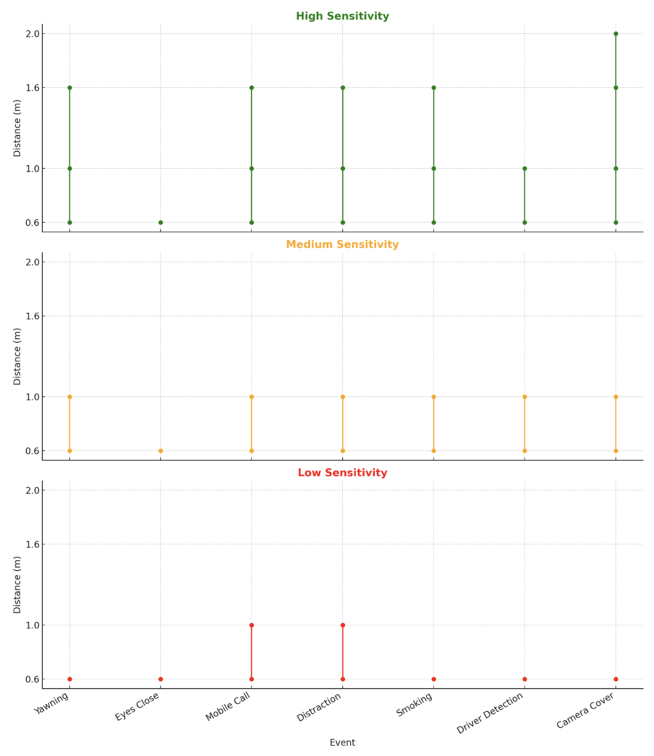
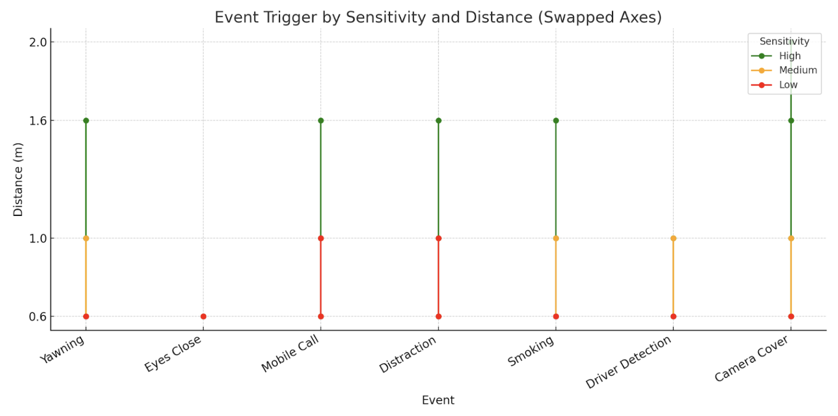
Benchmarking requires evaluating how precise and consistent alerts are at different distances in a camera, while minimizing false positives. Using Camera 1, which allows sensitivity adjustments, we conducted tests across various scenarios at 0.6 m, 1 m, 1.6 m, and 2 m. The results demonstrate how configuration impacts both the reliability of driver monitoring alerts and the overall trustworthiness of the camera system.
By adjusting the sensitivity settings of the camera, tables were created to show the maximum distance at which events are consistently detected. These tables can then be translated into graphs, providing a clear visualization of the camera's effective detection range. This approach makes it easier to see where the camera performs reliably and where detection begins to drop off.
**High sensitivity**
| Yawning | ✅ | ✅ | ✅ |
|
The results clearly show that camera sensitivity directly influences detection performance. At high sensitivity, cameras capture a wider range of events and distances (0.6 m to 2.0 m), but this may also introduce more false positives. In contrast, medium and low sensitivity settings narrow the detection range (down to just 0.6 m to 1.0 m), reducing noise but risking missed events.
For fleet managers, this trade-off is critical. False alerts can overwhelm drivers and operations teams, leading to unnecessary interventions. On the other hand, missed alerts compromise safety, risk driver accountability, and may even affect insurance claims if incidents go undocumented. But we can make sure this camera will respond successfully even though the sensitivity is low and the camera stands no further than half meter.
## Benchmarking HDR: measuring camera performance in brightness extremes
High Dynamic Range (HDR) technology is essential for cameras to adapt to both extreme brightness and low-light conditions, ensuring that critical incidents are captured with clarity. Whether a driver faces direct sunlight, shaded roads, or nighttime environments, HDR helps preserve key visual details such as license plates, road signs, and driver actions.
From a benchmarking perspective, HDR can be evaluated through measurable factors such as:
* Dynamic range (dB or stops); the ratio between the brightest and darkest areas the camera can capture without losing detail.
* Low-light performance (lux thresholds); the minimum light level at which a face or plate remains identifiable.
* Video consistency across conditions; comparing frame quality in high contrast scenarios (e.g., tunnels, sunset glare, headlights at night).
By incorporating these benchmarks, fleet managers can differentiate between cameras that truly deliver reliable evidence and those that may fail in critical scenarios. Ultimately, this means greater trust in incident reports, stronger insurance claims, and safer fleet operations.
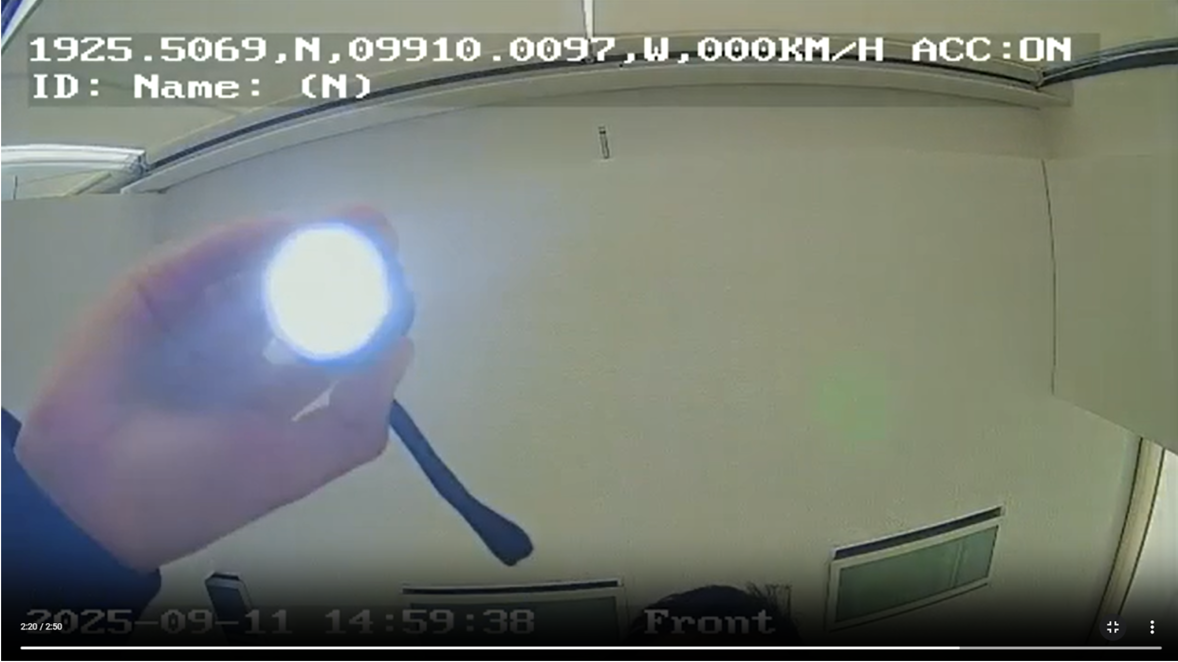
Let's look at an example from two cameras in the laboratory and compare how they respond to a flashlight.
**Camera 1:** The light source is still intense, but surrounding details (hand, ceiling, face outline) remain more visible, indicating better HDR response and lower lux tolerance.
**Camera 2:** The bright light causes strong overexposure, washing out much of the surrounding detail (poor HDR handling).
### Benchmarking HDR and lux response
| Camera | Dynamic Range (approx. dB) | Lux Threshold (approx. detection limit) | Observations |
| -------- | ------------------------------ | ------------------------------------------------ | ------------------------------------------------------------------------------------------------- |
| Camera 1 | \~65–70 dB (mid-to-high range) | \~20–30 lux minimum (better low-light tolerance) | Maintains visibility of hand, ceiling, and facial outline despite glare; stronger HDR capability. |
| Camera 2 | \~55–60 dB (low-to-mid range) | \~50–100 lux minimum (struggles in low light) | Severe overexposure from flashlight; surrounding details lost; limited HDR adjustment. |
Camera 2 clearly struggles to execute the necessary contrast adjustments during image processing. However, additional field-testing could determine whether its image sharpness improves under different conditions.
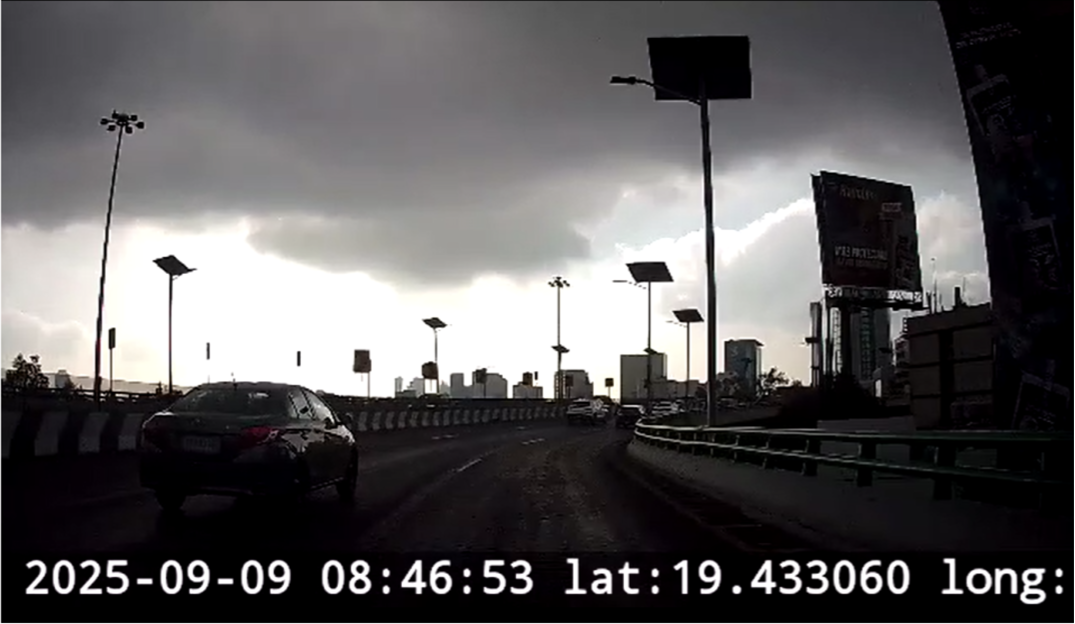
The vehicle was in transit at 8:46 AM on a cloudy day.
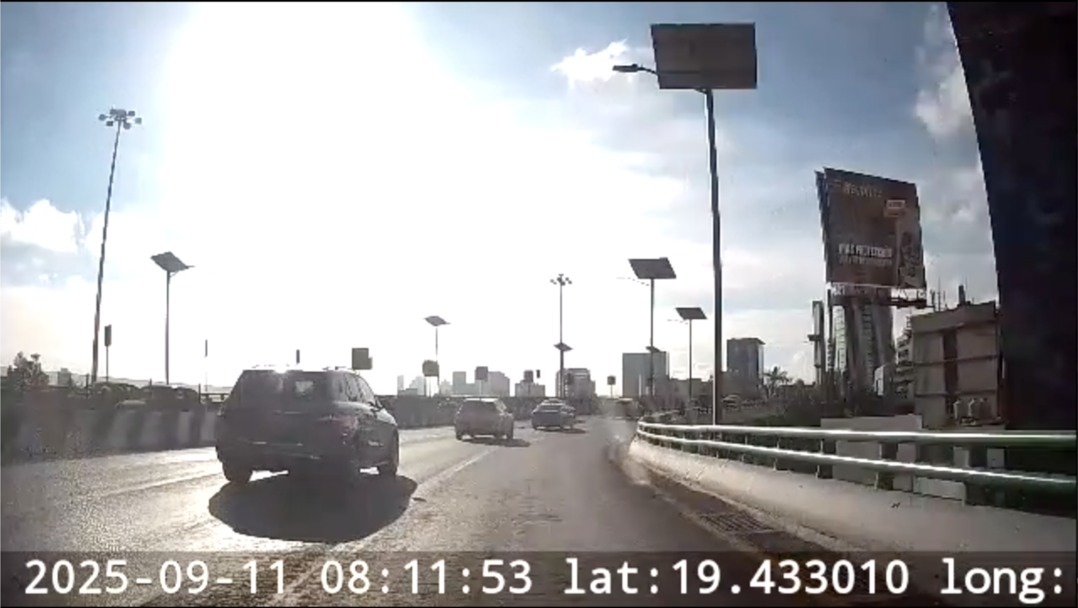
The vehicle was in transit at 8:11 AM on a bright day.
\
Both events, triggered at the same location on different days, were flagged as harsh turns. However, the image clarity of the camera makes it difficult to interpret the surrounding environment. On cloudy day, the scene is dominated by darkness: nearby objects appear almost as shadows, with a strong bright background but little visible detail elsewhere. On the bright day, the opposite problem occurs: excessive glare washes out the image, obscuring key information. In both cases, license plates and other critical details are not visible, which would severely limit the usefulness of the footage in the event of an incident or dispute.
### When details matter: benchmarking dashcams in the harshest light shifts
When fleet vehicles travel through tunnels, cameras face one of the toughest tests of video reliability. The sudden shift from bright daylight to near darkness, and back to intense sunlight, pushes HDR (High Dynamic Range) and light response to the limit. If a camera fails here, critical details like road signs, license plates, or surrounding vehicles can be lost, making footage unreliable for coaching, safety, or insurance claims. Camera 2 shows this response from the change light crossing in a tunnel.
### What this means
In a 14-second tunnel crossing, we tracked brightness across frames:
* Minimum brightness (inside tunnel): \~58
* Maximum brightness (exit glare): \~103
* Mean brightness: \~89
* Standard deviation: \~15.3
This fluctuation shows that while the camera adapts, transitions are not perfectly smooth. Some detail is sacrificed at both ends of the brightness range.
Our tunnel video analysis shows why structured benchmarking is essential. During the 14-second crossing, brightness dropped sharply on entry, stabilized briefly inside, and then spiked at the exit, revealing how the camera adapts to extreme light transitions. While it managed the shift, the fluctuations left some frames washed out or underexposed, limiting their reliability as evidence. This is exactly what benchmarking uncovers: not just whether a dashcam can record, but whether it can consistently deliver usable detail when lighting changes suddenly. For fleet managers, such benchmarks provide a clear, data-driven basis for comparing cameras and selecting the one that will hold up in the toughest real-world scenarios.
## Conclusion: what makes dashcam video reliable for fleets
Reliability in dashcam video is not defined by marketing specs like 1080p or 4K, but by how well a camera performs under the unpredictable realities of fleet operations. From sudden light shifts in tunnels, to glare-filled mornings, to dimly lit environments, the true test of a device lies in whether it can consistently capture usable details when it matters most.
Our benchmarking results highlight three core insights:
1. Feature priorities must align with fleet needs. Driver behavior monitoring, incident detection, and real-time alerts rank as the most critical functions, but their effectiveness depends on the underlying camera hardware.
2. Sensitivity settings shape trust in alerts. High sensitivity expands detection range but risks false positives, while low sensitivity reduces noise but may miss critical events. Only benchmarking reveals the balance that delivers actionable insights without overwhelming drivers or managers.
3. HDR and light adaptation determine clarity. Cameras that fail to manage brightness extremes or low-light conditions risk losing crucial evidence. Benchmarking HDR response, lux thresholds, and consistency across scenarios exposes these weaknesses before they compromise safety or insurance claims.
For fleet managers, the lesson is clear: a reliable dashcam is not the one with the flashiest specification sheet, but the one proven through structured benchmarking to deliver clarity, consistency, and trust across real-world conditions. Establishing standardized benchmarks gives operators the confidence that their investment will hold up under pressure, ensuring safer drivers, stronger claims support, and more resilient fleet operations.
---
# Agent Instructions
This documentation is published with GitBook. GitBook is the documentation platform designed so that both humans and AI agents can read, navigate, and reason over technical content effectively. Learn more at gitbook.com.
## Querying This Documentation
If you need additional information that is not directly available in this page, you can query the documentation by asking a question.
Perform an HTTP GET request on the following URL with the `ask` and `goal` query parameters:
```
GET https://navixy.com/docs/expert-center/vehicle-telematics-technology/video-telematics/video-telematics-101/what-makes-dash-cam-video-reliable-for-fleets-a-benchmarking-guide.md?ask=&goal=
```
`ask` is the immediate question: it should be specific, self-contained, and written in natural language.
`goal` is what the user is ultimately trying to achieve, the reason they need the answer. Sharing it helps GitBook give you a better, more relevant answer. A goal is most helpful when it describes the outcome the user wants rather than restating the question. For example, with `ask=how do I create an API token`, a goal like `automate deployments from our CI pipeline` lets GitBook tailor the answer to that use case.
The response will contain a direct answer to the question and relevant excerpts and sources from the documentation.
Use this mechanism when the answer is not explicitly present in the current page, you need clarification or additional context, or you want to retrieve related documentation sections.

.png?alt=media)