Telematics Talks

    Conversations with industry leaders on telematics, data platforms, and connected operations.

    Also available onSpotifyApple PodcastsAmazon Podcasts

    Read transcript

    Episode 11: E-Mobility, Mixed Fleets & GNSS Accuracy with Kseniya (Teltonika)

    Vlad: Hello everyone, and welcome back to Telematics Talks. I'm Vlad, Operations VP at Navixy. Today's episode is special because we're diving into one of the hottest shifts in fleet tech right now: mobility. A lot of our customers are running mixed fleets — EVs alongside ICE vehicles — and they're balancing charging uptime and sustainability targets while still demanding rock-solid location data.

    Kseniya: I find telematics a really interesting niche. Almost every project is unique, and for each client you need to find a special approach. The challenge I solve every day is: how do I communicate the message in a way that fits different markets.

    Vlad: What helps you make that shift between light e-vehicles and heavy trucks?

    Kseniya: You need to be ready for different implementations. When designing a product, we look not only at the engine type, but at the use case. The secret is to consider the overall use case — what size the device should be, what data needs to be read, what certifications are needed.

    Vlad: What would you recommend as a starting point for someone new to this?

    Kseniya: First, analyze the local context. What industries are booming? What is the local regulation? When it comes to EVs, some countries mandate emission levels. I'd recommend looking at emerging businesses like car sharing, last-mile delivery, and personal micromobility.

    Vlad: What was the main challenge in making EV integrations work?

    Kseniya: For data integration, we give partners the possibility to specify what parameters should be collected based on the vehicle's protocol. This gives them freedom to work with specific EV models. For the most common vehicles, we already have supported integrations.

    Vlad: What about firmware updates mid-deployment?

    Kseniya: The only way to handle it is over-the-air updates. Without that, it would be extremely hard to maintain hundreds of thousands of devices in the field.

    Vlad: What are the main KPIs customers need to show their managers?

    Kseniya: In the EU there are CO₂ emission targets. Telematics provides visibility and allows businesses to compare costs of fuel vehicles versus electric vehicles. Businesses want to see: "I'm investing X money — what mileage do I get, how often do I need to charge?"

    Vlad: What dashboards should include in the first week of testing?

    Kseniya: Monitor state of charge and state of health of batteries, plus charging habits. If batteries aren't charged properly, it impacts lifespan — and replacement costs money. Also useful: showing the nearest charging stations.

    Vlad: Would you recommend an external backup battery for scooters?

    Kseniya: Yes, 100%. You want to track a scooter not only during trips, but also when parked. If it gets stolen and there's no power, you lose visibility. It's an investment in security and business stability.

    Vlad: What's new for improved location accuracy?

    Kseniya: First: increasing satellites visible — the latest generation can track more than 40 satellites. Second: dead reckoning — technology that tracks the vehicle even without satellite coordinates, using gyro and accelerometer.

    Vlad: Any success stories with improved precision?

    Kseniya: A sharing service in the Middle East — precision helped them see exactly where scooters were parked, analyze user behavior, and place parking spots accordingly. They told us they grew by 27% thanks to this solution.

    Vlad: What advice for software providers working with hardware?

    Kseniya: Staying in touch with us. Dialogue between hardware and software partners is crucial — we need to work together to provide a full solution. If you have a project, come to us, we'll help figure it out.

    Vlad: This has been Telematics Talks. Until next time — stay efficient, stay accurate, and keep moving.


    Download transcript

    What is Telematics Talks

    Insights, trends, and expert conversations shaping the telematics and IoT industry.

    Cases

    Implementation stories

    Implementation stories with architecture, constraints, and results.

    Playbooks

    Business strategies

    Business model fit, partnerships, pricing, go-to-market, and where telematics is heading.

    Industry insights

    Market & tech trends

    Signals from the field: regulations, AI and video telematics, connectivity, data security, and what fleet operators will expect next.

    Industry leaders who have joined us

    TeltonikaJimi IoTLightMetricsMettaxQueclinkStreamax
    TeltonikaJimi IoTLightMetricsMettaxQueclinkStreamax

    Telematics Talks in numbers

    A growing global media platform for telematics and IoT professionals.

    20K+
    Estimated total reach per episode*
    5.5K
    Avg YouTube views (long-form)
    35+
    Countries

    * Estimate based on the last 10 episodes and cross-channel distribution: YouTube, LinkedIn Live, Shorts, blog/social, email distribution, and podcast platforms.

    Global Coverage

    USA, Latin America, Europe, Middle East & Africa. Content in English and Spanish.

    Decision Makers

    Founders, CEOs, CTOs, Engineering Leaders, Fleet Operations.

    Key Industries

    Logistics, Mining, Heavy Equipment, Last Mile Delivery, Vehicle Rental.

    Featured episodes

    Watch the latest Telematics Talks episodes from industry leaders.

    Telematics Talks Episode 10
    Watch Episode

    In this episode, Oscar Zhang (Jimi IoT) explains how event-based video telematics helps fleets capture the right video evidence without exploding data costs. We discuss smart uploads, buffers, offline handling, storage reliability, security events, and cross-border connectivity.

    Read transcript

    Episode 10: AI-Driven Event-Based Video Telematics with Oscar Zhang (Jimi IoT)

    Vlad: Hello everyone, and welcome back to Telematics Talks. I'm Vlad, Vice President of Operations at Navixy. Today's episode is special because we're talking about AI-driven, event-based video telematics. Our guest today is Oscar Zhang, General Manager of the DVR business unit at Jimi IoT — the team behind the G-series multi-camera AI dash cams used by fleets across 180+ countries.

    Oscar: Nice to meet you too. I'm doing well, thank you.

    Vlad: My first question is: what actually motivated you? What was that exact moment when you thought, "Yes — video is essential, not just a nice-to-have"?

    Oscar: Early in this industry, the main focus was location tracking — basic telematics. Video was often seen as an extra. If I had to pinpoint a moment that really shifted my thinking, it was during a customer visit. The customer was a logistics company that adopted our video solution. After only a few months, they showed me the results — reduced operational costs and sharply reduced road incidents. They told me: "It's not just a camera — it's a witness." That really shifted my perspective.

    Vlad: Do you think live streaming, continuous streaming, is really worth it?

    Oscar: I wouldn't say "never," but it only makes sense in specific cases — short-haul, high-value operations. For most logistics fleets, it's too expensive and wasteful. That's why we shifted from continuous streaming to an event-based smarter system that captures what really matters.

    Vlad: What's the main pain point for fleets?

    Oscar: Generally I'd summarize three main pain points. First: operational cost — data costs, time spent reviewing clips, and financial risk of missing a video event. Second: safety and security of the vehicle, cargo, and drivers. Third: regulatory compliance — many countries are releasing new regulations around driver behavior, working hours, and security standards.

    Vlad: What should the main settings be when starting with customers?

    Oscar: For driver safety, the most important are speeding, ADAS, and DMS — anything that helps detect risky driving behavior. Alerts like SOS or collision are the highest priority because the operations team needs to respond quickly. We suggest high-priority alerts should be sent to the cloud immediately. Lower-priority events can wait.

    Vlad: What would be the standard buffer time for collision detection?

    Oscar: We typically have a default of 15 seconds total: about 7 seconds before the event and 8 seconds after. But it can be configured longer — 30 seconds or even 60 seconds total. If one clip isn't enough, the fleet manager can request longer normal recording.

    Vlad: What's your suggestion for cross-border delivery, where roaming becomes expensive?

    Oscar: Recently we've heard customers asking to integrate multi-IMSI SIM cards. When the vehicle moves to another country, the SIM can use a local identity — which gives lower cost and more stable connectivity.

    Vlad: What about loss of connectivity? What happens when connectivity comes back?

    Oscar: When the device reconnects, it should send real-time data first. If the device detects jamming, that event should be sent as a high priority immediately — it could mean theft or something serious. We record it, create logs, and protect that footage so it can't be overwritten.

    Vlad: What's your recommendation for a basic cargo safety setup?

    Oscar: First you need driver and road-facing cameras: one for ADAS, one driver-facing (DMS). For cargo, we recommend a rear camera and a camera on top near the rear door. Also, a camera inside the cargo bay facing the door can be useful. With accessories like door sensors, when the door opens, the camera can start recording.

    Vlad: For cargo security and tamper protection, what are the must-have alerts?

    Oscar: If someone jams the device, cuts power wires, or covers the lens, the device should upload those alerts immediately to the server. Our device detects jamming by identifying abnormal signal patterns — location suddenly becoming inconsistent, or signal behavior becoming abnormal.

    Vlad: Oscar, thank you for sharing your perspective on video telematics — this was really insightful. We covered cargo safety, data consumption, and a lot more. This has been Telematics Talks. Until next time — stay safe on the road.

    Download transcript (.txt)
    Telematics Talks Episode 7
    Watch Episode

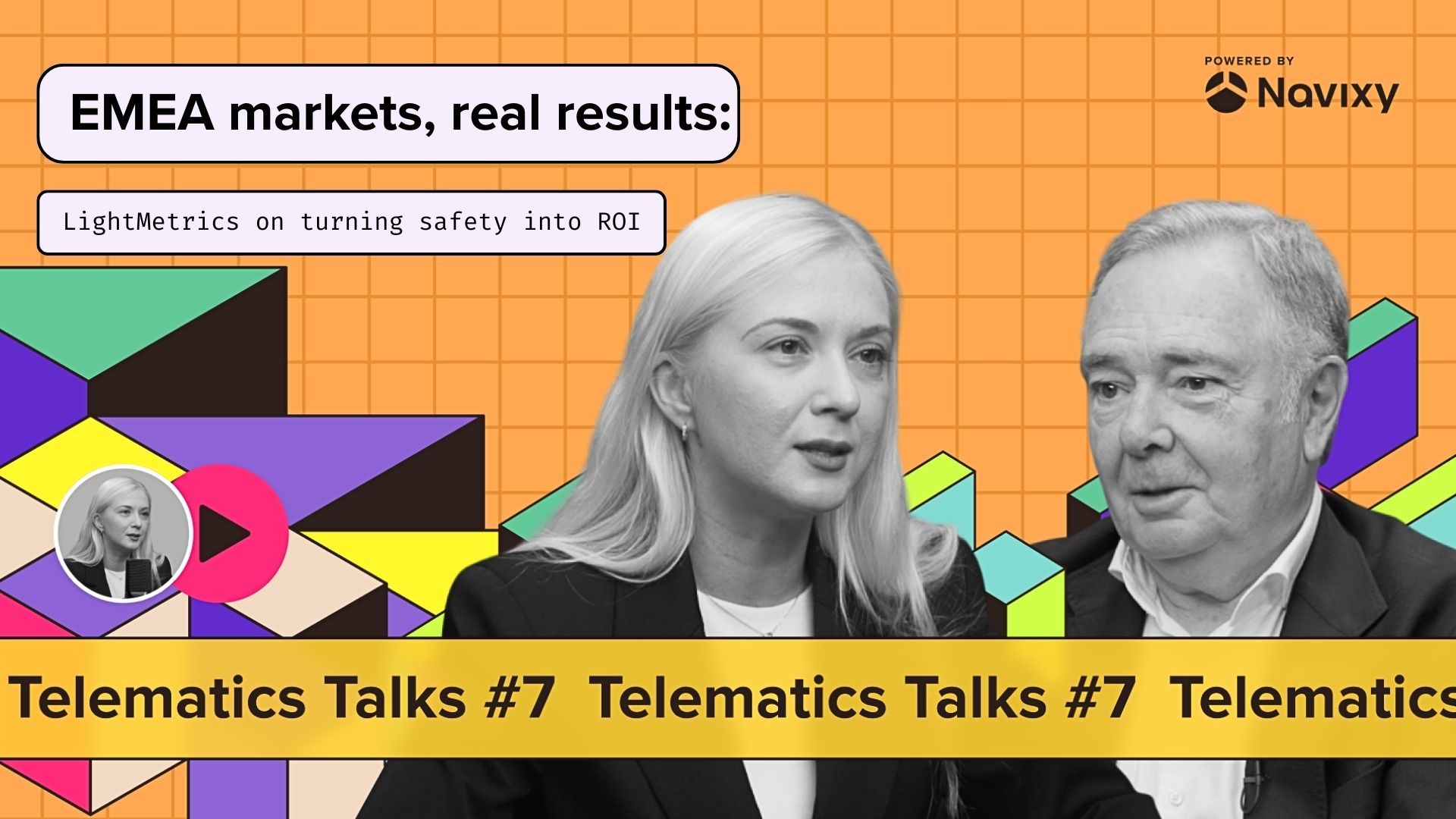
    In this episode, Navixy's Natalia Antipova speaks with LightMetrics' David Brazell about how fleets in EMEA make AI video telematics pay for itself. They cover accident prevention, cutting video/data costs, and why edge AI matters when connectivity is weak.

    Read transcript

    Episode 7: AI Video Telematics ROI in EMEA with David Brazell (LightMetrics)

    Natalia: Hello everyone, and welcome back to Telematics Talks. I'm Natalia from the Partnerships team at Navixy. Today we're talking about AI-powered video telematics. We recently added LightMetrics RideView to our Marketplace, giving partners an easy way to bring video intelligence to their fleets.

    David: I first got engaged with telematics back in 2011. What really hooked me was taking data, turning it into insights, and creating real impact. Roughly 1.3 million people die in road accidents every year — every 24 seconds, someone is killed. What we do is help partners use this technology to reduce risk and save lives.

    Natalia: Where do you see the strongest demand in EMEA today?

    David: In the EU, the General Safety Regulation requires safety measures in all new cars. That created a big aftermarket opportunity — fleets have mixed vehicle ages, average 12 years in EU. In Africa, it's more security than safety — fleets need evidence and visibility. In the UAE, authorities like the RTA are implementing safety tech. So where regulation exists, adoption accelerates.

    Natalia: How do you frame ROI for a fleet owner in Dubai or Riyadh?

    David: Yes, there is an ROI. In mining, the number-one risk driver is drowsiness. In-cab alerts prevent serious incidents. We often see around 85% reduction in risky behaviors early on. And when you improve driving behavior, you also improve fuel consumption and reduce wear and tear.

    Natalia: How does LightMetrics solve the "cost and connectivity" problem?

    David: We released neural network video compression (NNVC). On a 128GB SD card, we can extend storage by about 3x — closer to a month of retention. It also reduces upload costs — around 65% less data usage. The "magic" happens on the camera (edge AI). Even without connectivity, events are detected, driver alerts work, and everything is stored locally.

    Natalia: How do you help partners comply with local hosting requirements?

    David: We use AWS and support regional hosting. We're working toward becoming cloud-agnostic to support on-prem or in-country hosting where required. We own the whole stack — our own AI team and cloud infrastructure team.

    Natalia: What innovations will matter for fleets in the next few years?

    David: "Talk to data" — using AI to query risk and performance quickly. Self-coaching workflows — enabling drivers to coach themselves through an app. And neural network video compression — it directly impacts ROI, which is what fleets care about.

    David: My key message: video telematics is complex, and our job is to simplify it for partners. Everything we do is about reducing risk on the road and saving lives. Drivers are at the center, and we want to make sure they get home safely to their families.

    Download transcript (.txt)
    Telematics Talks Episode 6
    Watch Episode

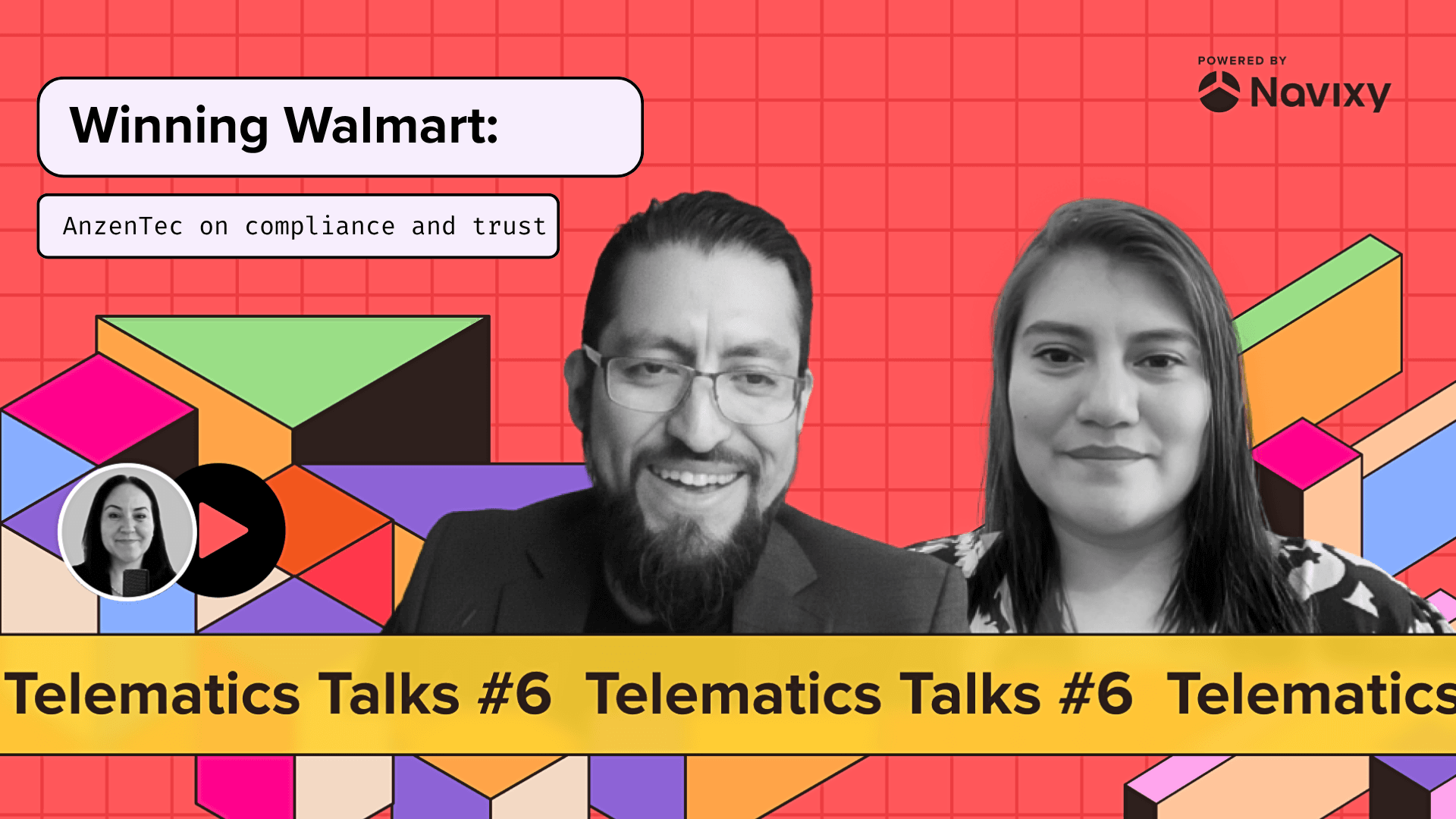
    In this episode, AnzenTec and Navixy show how Mexico-based logistics providers win big retailers like Walmart by sharing secure, audit-ready live data such as location, temperature, ignition, and speed. You'll learn how to use mirror accounts and flexible access controls to deliver cold-chain visibility, retail compliance, and customer-ready tracking updates.

    Read transcript

    Episode 6: Geolinks & Cold-Chain Visibility with Jorge Estrada & Marta Ugalde (AnzenTec)

    Myrena: Hello, good morning. I'm Myrena Martinez, Customer Success Manager at Navixy. Today we're talking about Geolinks and freight transportation with Jorge Estrada (CEO) and Marta Patricia Ugalde (CFO) of Anzentec — a leading company offering innovative technology solutions for transportation in Mexico.

    Jorge: Anzentec offers advanced telematics solutions for efficiently managing heavy transport operations. We also work with machine learning and comprehensive data analysis, providing clients with tools for financial and operational decisions.

    Myrena: What does a typical day look like for a heavy transport client?

    Jorge: A heavy transport client faces the challenge of moving cargo from A to B. We provide technology so the client has visibility throughout the entire process. A typical day is full of phone calls and urgent matters — follow-ups, blockages, constant coordination. That's where we come in.

    Myrena: How did things change with Geolinks?

    Jorge: Geolinks are essential for the transportation market in Mexico. From the carrier's perspective, you need to share reliable updates about cargo status. From a security perspective, you can't share full platform access. Geolinks let clients share shipment status with end customers in a simple, secure way.

    Jorge: With major customers like Walmart, Geolinks share not only location but specific sensor data: speed, ignition, and temperature. The link doesn't expose license plates — it shows a reference number, 15 minutes of history, and key sensors.

    Myrena: What about link duration and security?

    Jorge: Duration is very dynamic. Clients can schedule links ahead of time — activating Monday at 6:00 AM and deactivating Tuesday at 7:00 PM. They can configure geofences, cut off access immediately if they suspect a vulnerability, and generate a new link in minutes.

    Jorge: New regulations for freight transport now require tracking data to be shared with regulators. We already fulfill those requirements with Navixy.

    Marta: Real-time tracking and alerts can help prevent accidents or manage incidents when they happen — that's exactly the value of Geolinks. Compared to WhatsApp or phone calls, it's a huge improvement.

    Jorge: Customers don't care about features — they care about whether you solve their problem. A Geolink can help you close a deal with Walmart. It helps ensure the shipment arrives safely, doesn't spoil, and meets requirements. That's the essence.

    Download transcript (.txt)
    Telematics Talks Episode 4
    Watch Episode

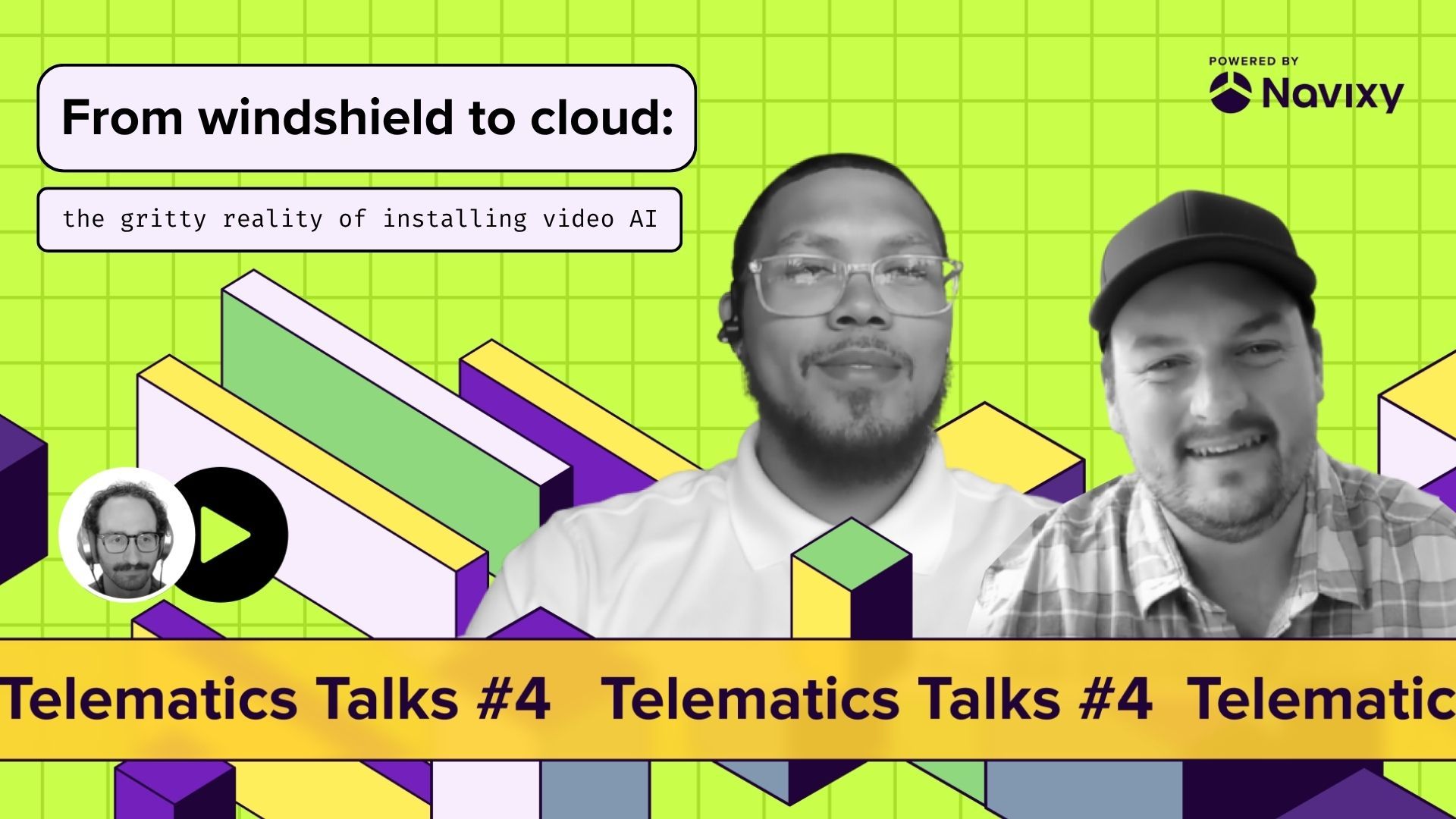
    In this episode, cloud experts Tanner Cox (Via-Teck) and George Haskins (HD Fleet) share checklists and scaling tips for installing AI dash cams. Learn U.S. best practices for legal placement, clean wiring, reliable connectivity, and calibration to reduce false alerts.

    Read transcript

    Episode 4: AI Dash Cam Installation Best Practices with Tanner Cox (Vietek) & George Haskins (HD Fleet)

    Host: Today we're getting practical — the person inside the cab with the trim tool and fuse taps, and the engineer in the office provisioning hardware. We'll dig into the messy realities of installs — laws, quirks, tech limits, and what it costs if you don't get it right.

    Tanner: The well-known problem vehicles are Volvos and some Freightliners. We always take FMCSA and DOT guidelines into account from the start. We provide a guideline sheet that certifies the installation is within those guidelines — so if drivers get pulled over, they can handle it on-site.

    George: We can see everything remotely in the platform as long as the camera has power. We can give installers temporary access so they can check the camera view on their phone — including the in-cabin position for AI events.

    Tanner: We base our installation guidelines off California standards — they're the strictest. If it meets California DOT standards, it meets pretty much anybody's standards worldwide.

    George: We ship cameras with audio disabled from the get-go. We want drivers to have privacy. When customers need audio — like in NEMT — they submit a support ticket and it's enabled quickly.

    Tanner: The biggest thing is transparency. This isn't a spying device — it's a safety device. If a driver gets in a wreck and there's false blame, the camera can save jobs and lives. Transparency is key.

    Tanner: The most common reason for battery drain is incorrect wiring — ignition hooked to constant power. If installed correctly, it shouldn't drain the battery unless the vehicle sits for a month.

    George: On our platform we can pull battery voltage immediately. Vietek takes photos before and after installs, so if I see voltage dropping, I can check the install photos.

    Tanner: We tell customers the first 15-20 minutes are important for calibration. A Honda Civic is different from a Freightliner Cascadia. OEM systems usually refine within a day or two.

    George: Most calibration can be handled remotely. If it can't, nine times out of ten it's hardware — we ship a replacement camera and return the faulty one.

    Tanner: Verizon has been the most reliable, especially in remote areas. We check signal ahead of time and give customers a list of sites that may not come online immediately.

    George: All our videos are watermarked with date, time, speed, and location. We had a case where the watermark proved a vehicle was at a complete stop during an accident — it helped save them millions in court.

    Tanner: The cheapest shortcut that blows up later: Scotchlocks or T-taps. We've seen those cause thermal events. Proper wiring matters — strip, butt connector, heat shrink, or solder.

    Download transcript (.txt)

    Share your expertise

    Become a guest and showcase your expertise to the global audience of telematics professionals.

    Explore all episodes