Telematics transformation: from SaaS to AI infrastructure

AuthorDenis Demianikov
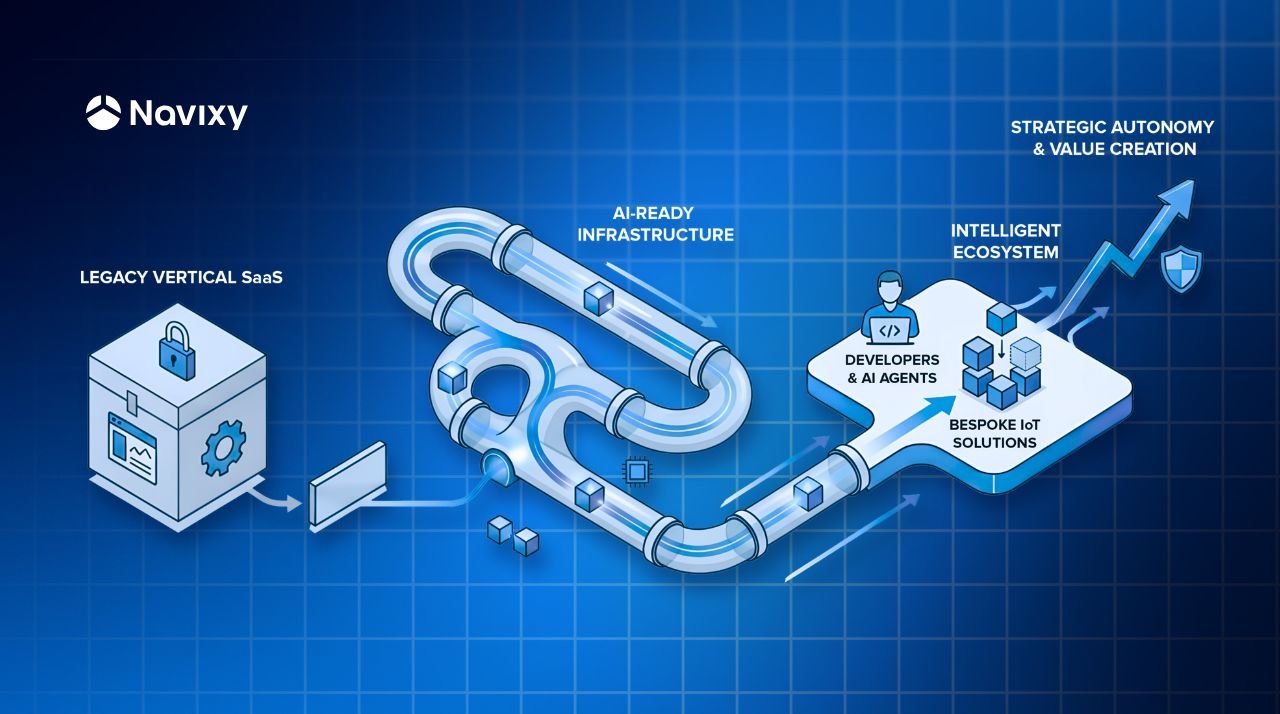
For over a decade, the telematics industry has relied on vertical SaaS ecosystems – closed, pre-defined solutions for fleet management, IoT monitoring, and reporting. While these tools solved immediate operational problems, they created a structural ceiling for innovation. Today, businesses expect technology to adapt to processes, not the other way around.
Now, a fundamental shift is underway: data and compute are being decoupled from rigid applications. Organizations can leverage high-fidelity data, modular software, and AI-ready infrastructure to build tailored solutions, turning raw signals into actionable business insights.
The future isn’t just smarter dashboards and beautiful interfaces – it is AI-centric systems and intelligent agents that streamline workflows, enhance decision-making, and unlock strategic autonomy across integrators, resellers, and end-users.
Atomic resources and the architectural core
The telematics platform of the future is not a suite of finished applications; it is a provider of atomic resources: high-fidelity data, compute power, and modular software components. This foundation is built to facilitate a new partnership between human and AI orchestration.
By delivering infrastructure as a service, we move from buying a tool to operating a refinery. This allows enterprises and integrators to leverage raw data and computational power to build bespoke solutions without the friction of managing the underlying "plumbing." It is a shift from consuming static features to controlling a dynamic data pipeline where raw signals are refined into strategic assets in real-time.
Collaborative intelligence and UX evolution
In this environment, the User Interface (UI) is no longer the destination – it is a context-aware bridge. We are moving toward AI-centric environments where interaction occurs through intelligent intermediaries that act as high-bandwidth co-pilots for human decision-makers.
This is a collaborative pipeline: infrastructure handles the massive data throughput, while creating and adapting interfaces provide the clarity needed for human intervention. Technology finally aligns with the human process, ensuring that managers focus on strategic exceptions while AI handles the operational baseline. The result is the elevation of the human element through a human-in-the-loop model.
AI agents as force multipliers
AI agents, leveraging SLMs (Small Language Models) and LLMs (Large Language Models), serve as the catalysts in this new architecture. They speak the professional language of the industry, automating routine workflows and refining raw signals into actionable intelligence.
For the organization, this creates a significant shift in internal velocity. The strategic outcome is clear: expanded margins and a faster path to objectives, as teams move from manual data analysis and workflows to high-level system orchestration and decision making.
These AI agents establish a new intelligence layer that sits between the raw infrastructure and human decision-makers. Acting as proactive middleware, this layer continuously translates low-level data events into high-level strategic context, ensuring that the organization doesn't just react to data, but anticipates strategic inflection points.
The new economics of the value chain
The shift to AI-ready infrastructure replaces legacy cost constraints with an infrastructure-centric unit economic model. For classic resellers and integrators, this unlocks a path out of the commodity trap.
For integrators: the model functions as an IaaS (Infrastructure as a Service). They acquire the core resources – data, compute and modular software components – to architect unique, high-margin solutions. This allows them to price services based on tangible business outcomes (e.g., TCO reduction or performance optimization) rather than simply marking up a vendor's license.
For end organizations: pricing becomes transparent and elastic. They pay for the underlying environment that powers their growth, ensuring that technology spend is always proportional to the complexity and scale of their operations.
Ultimately, this moves the entire industry away from monetizing access to static features and toward monetizing the creation of verifiable business value.
The two-layer architecture
This infrastructure organizes the telematics ecosystem into two distinct, high-value layers:
The enabling layer: integrators, VARs, and developers who use foundational resources and AI agents to assemble and adapt solutions for specific industrial scenarios with unprecedented speed.
The operational layer: decision-makers who utilize AI-centric environments, including web and mobile interfaces, and intelligent intermediaries that are inherently aligned with their unique organizational context and strategic goals.
By decoupling technical assembly from strategic usage, this structure accelerates time-to-value and ensures that sophisticated infrastructure capabilities translate into streamlined business outcomes.
Strategic autonomy and the future of value creation
This strategy, which defines the evolution of Navixy, is about providing the fuel (data) and the engine (AI-ready infrastructure) to drive any scenario. The future of telematics is not a battle of feature lists; it is a battle of pipeline velocity and architectural flexibility.
The winners of this decade will be the organizations and partners who move beyond closed boxes and begin building on an infrastructure where technology, data, and human intelligence are fused into a single system. The question for the C-suite is no longer "which software to buy," but "which infrastructure will define the company’s operational autonomy for the next decade?"