Turning Ford OEM telematics data into fleet automation

AuthorSvyatoslav I., Product Manager, Navixy IoT Logic
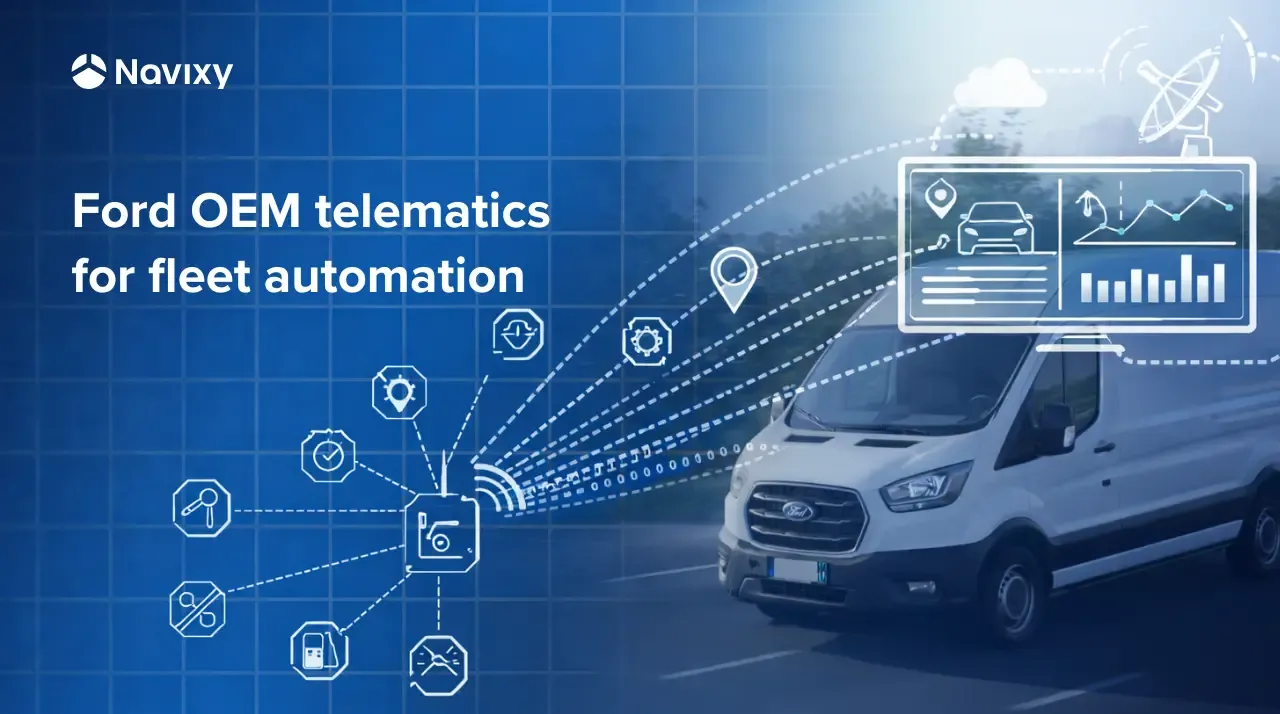
Every new Ford Transit, F-150, or E-Transit rolling off the line already streams telematics data through its FordPass Connect modem. Yet most TSPs still install aftermarket trackers in these vehicles, adding hardware costs, scheduling installer visits, and delaying time-to-service. The vehicle is already connected. The data is already flowing. The question is whether you're using it.
Navixy now supports Ford OEM telematics as a native data source, which means TSPs can onboard Ford commercial fleets without shipping a single device. The activation process takes minutes, and vehicles appear online within 15 minutes. Ford vehicles transmit a rich set of data directly from the manufacturer’s embedded hardware, giving TSPs access to detailed and reliable telemetry without additional installation.
For TSPs serving delivery fleets, trade contractors, or service companies running Ford vehicles, this changes the economics of customer acquisition.
To see how Ford OEM integration and IoT Logic could work for your fleet clients, book a demo with our team.
What Ford OEM telematics brings to the platform
Ford's factory-installed modem transmits data directly from vehicle systems, not inferred from GPS breadcrumbs. TSPs gain access to fuel level readings, engine diagnostics, odometer values, ignition status, and speed data. These signals come from the vehicle's own sensors, which means higher fidelity than aftermarket devices relying solely on satellite positioning.
The integration follows a two-stage process. First, the service provider configures the Ford data feed in their Navixy account. Then the fleet operator activates each vehicle through the platform interface. No windshield clutter, no OBD port conflicts, no scheduling around vehicle availability.
This doesn't mean aftermarket devices become obsolete. Many fleets operate mixed vehicle makes, or need capabilities that OEM data doesn't cover (dash cameras, specialized sensors, trailer tracking). Navixy treats Ford OEM vehicles as first-class data sources alongside traditional trackers, so TSPs can manage the full fleet from one platform regardless of how each vehicle connects.
Why this matters for TSPs and solution builders
Consider the prospect conversation. A delivery company with 40 Ford Transits asks about telematics. With hardware-dependent solutions, the TSP quotes device costs, schedules installation windows, and manages the logistics of touching every vehicle. The prospect hesitates, the deal drags, sometimes it dies.
With Ford OEM integration, the TSP's pitch changes. "Your vehicles are already connected. We activate them remotely, and you're live by tomorrow." No hardware procurement, no installer labor, faster revenue recognition.
The margin profile shifts too. Without device procurement and installation overhead, the TSP's gross margin on Ford fleets improves substantially. That margin can fund competitive pricing, or it can flow to the bottom line.
Vertical markets with heavy Ford adoption benefit most. Delivery and courier fleets running Transit and Transit Connect. Trade contractors in F-150s and Super Duty trucks. Service companies with mixed light-duty fleets. These segments often resist telematics because of installation friction. OEM integration removes that objection.
Automating OEM data across operations with IoT Logic
Accessing Ford OEM data is the starting point, not the destination. Raw telemetry sitting in dashboards doesn't change operations. The value emerges when data triggers actions automatically.
IoT Logic is Navixy's node-based automation builder. It connects data sources (including Ford OEM vehicles) to condition evaluations and automated responses. The pattern is consistent: an event occurs, the system evaluates whether it meets specified criteria, and if so, executes one or more actions without human intervention.
This isn't the same as setting up basic alerts. IoT Logic supports attribute derivation (calculating new values from raw signals), complex conditional logic, parallel action execution, and integration with external systems through webhooks. It's programmable automation that adapts to operational requirements rather than forcing workflows into predefined templates.
Practical example: automated idle-time intervention using Ford OEM data
Fleet managers know idle time is a problem. Vehicles sitting at customer sites, loading docks, or job locations with engines running burn fuel without moving the business forward. A commercial vehicle idling for an hour can consume 1.9 to 3.0 liters of fuel. Across a 40-vehicle fleet with 30 minutes of unnecessary daily idle time per vehicle, that's roughly 1,200 liters per month in preventable fuel costs.
Traditional telematics handles this with trip reports that show idle time after the fact. The operations manager reviews the report, identifies offenders, schedules coaching conversations. By the time feedback reaches the driver, the behavior that caused the waste happened days ago.
IoT Logic introduces a new approach through automation. Let’s take a quick look at an example of automated idle-time intervention using Ford OEM data.
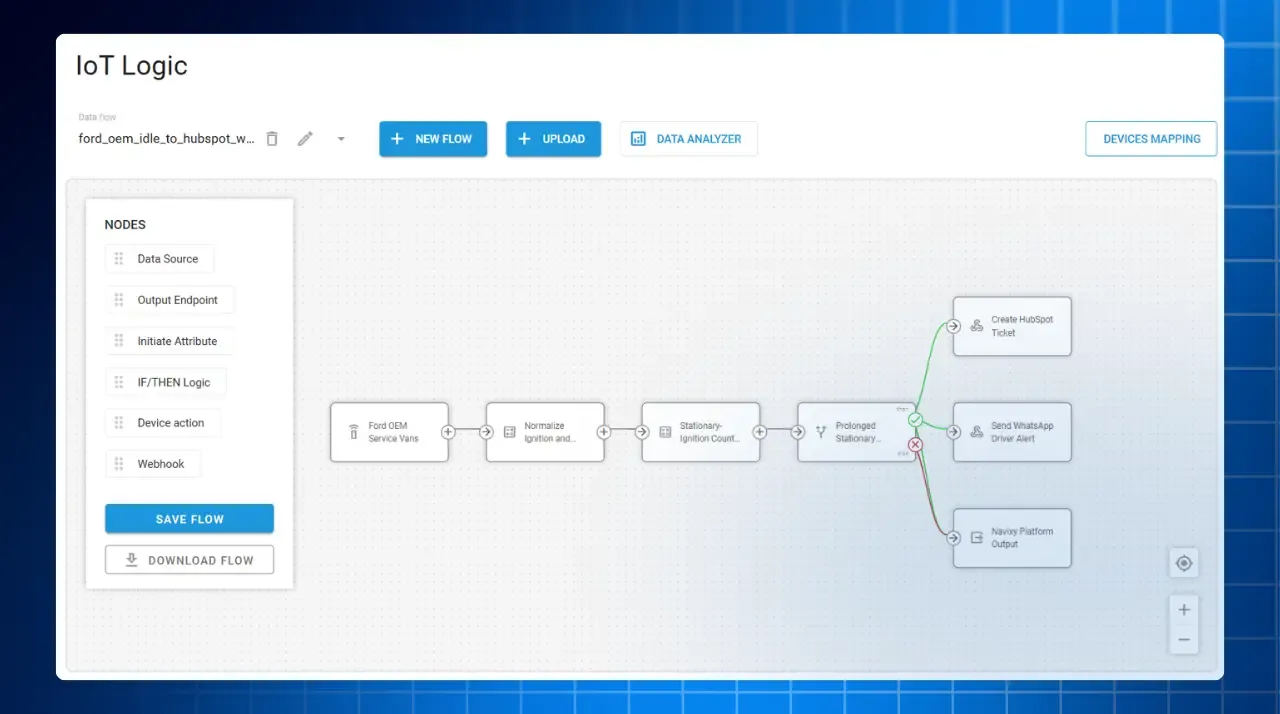
Data Source node. The flow starts by selecting Ford OEM devices as the data source. All vehicles with active Ford telematics feed into this workflow.
Initiate Attributes node. The system derives two calculated values. First, is_stationary evaluates whether speed is below 1 km/h. Second, is_stationary_with_ignition combines the stationary check with ignition-on status.
Logic node. The condition evaluates whether a vehicle has been stationary with ignition on for more than 12 minutes. This threshold distinguishes operational stops (quick deliveries, traffic) from wasteful idling.
Dual webhook actions. When the condition is met, two parallel actions fire. One webhook creates a ticket in HubSpot, giving operations visibility into which vehicles triggered idle alerts and when. The other webhook sends a WhatsApp message directly to the driver: "Reminder: your vehicle has been idle with the engine on for more than 12 minutes. Please turn it off when safe and practical."
Output Endpoint node. The event is logged for reporting and dashboard visibility, enabling trend analysis over time.
The dual-action pattern matters. Real-time driver feedback addresses the behavior when it's happening, not days later in a coaching session. The operations ticket ensures accountability and trend tracking without requiring someone to watch dashboards constantly.
Business outcomes and operational value
The mechanism produces measurable results. Real-time feedback reaches drivers when they can actually respond, which research suggests drives faster behavior change than retrospective reports. The operations team gains automatic documentation without manual monitoring. Fuel savings accumulate across the fleet, and engine wear from unnecessary idling decreases.
Because the logic applies to all Ford OEM vehicles in the flow, there's no per-vehicle configuration required. Add a new Ford vehicle to the fleet, activate it in Navixy, and the idle-time workflow applies automatically. Scalability without incremental setup effort.
What this means for your telematics business
Ford OEM integration and IoT Logic together represent a capability stack that differentiates TSPs from commodity tracking providers. The ability to onboard Ford fleets without hardware, combined with programmable automation that turns data into operational workflows, creates service offerings that competitors relying on device-only models can't easily match.
OEM telematics is expanding across manufacturers. TSPs who build competency now, understanding how to configure integrations and design automation flows, position themselves for a market where connected vehicles are the norm rather than the exception.