Your Next Integration Engineer Might Be an AI Agent
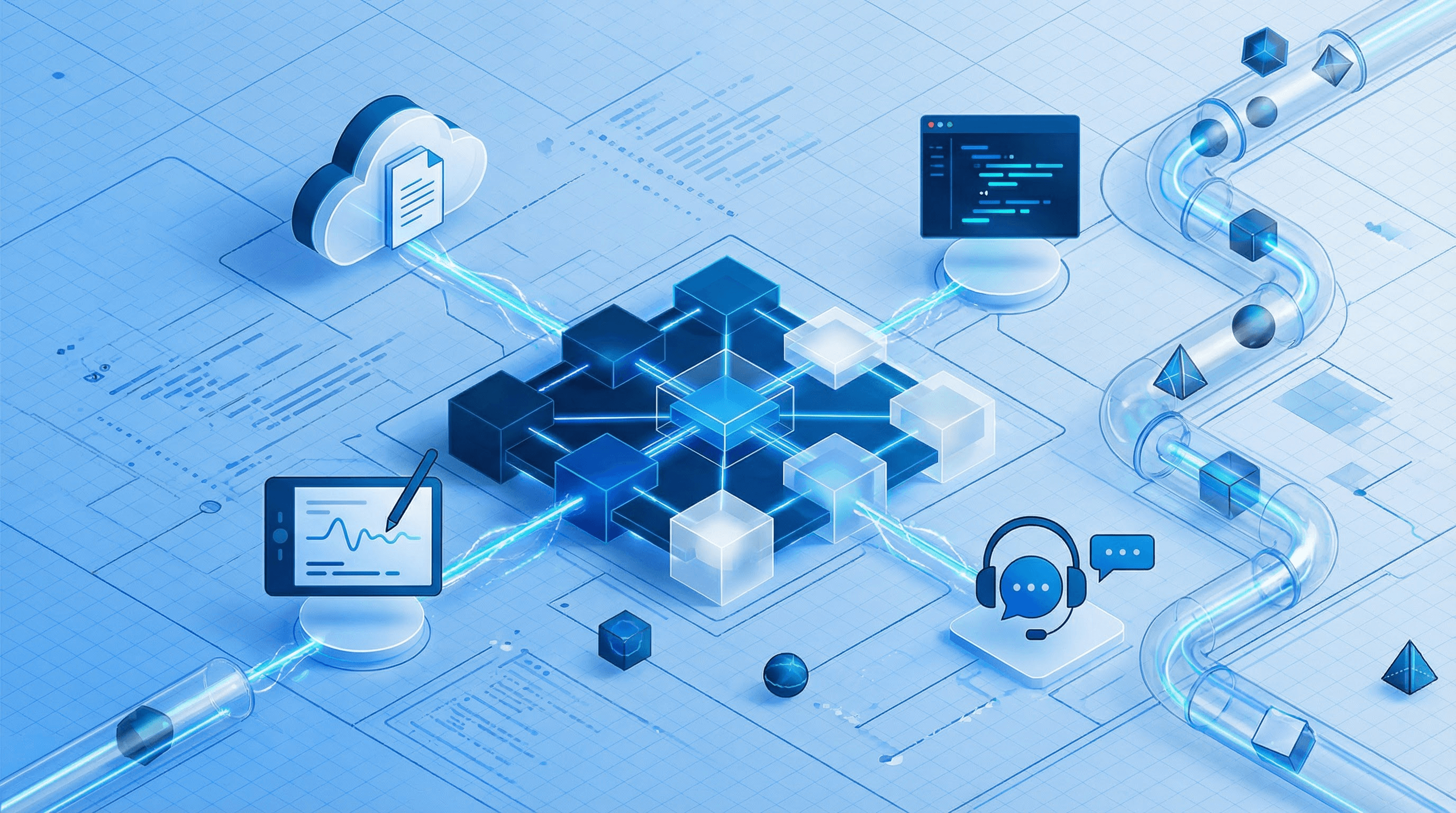
The developer debugging your API integration right now probably isn't doing it alone. They're pair-programming with Claude in Cursor, or asking Copilot to explain your authentication flow, or having ChatGPT parse your webhook payload format. Their AI assistant is trying to understand your platform — and in most cases, it's working blind.
This is the invisible user problem. The fastest-growing class of consumers of your platform knowledge aren't humans browsing your help center. They're AI agents operating on behalf of humans — and they can't see most of what you've built.
How we got here without noticing
Something shifted in the last eighteen months and most B2B platforms are still missing it.
Developers stopped reading documentation the way documentation was designed to be read. The old workflow — open the docs in a tab, search for the endpoint, read the parameters, switch back to the editor, write the code — is giving way to something faster. A developer working in Cursor asks "how does session authentication work in this API?" and expects a correct answer without leaving the editor. A solutions architect asks Claude to compare three platforms' geofence capabilities and expects a grounded response, not a hallucination.
The humans are still making decisions. But they've delegated the knowledge retrieval to AI agents. And those agents are hitting a wall: most platform knowledge is locked behind interfaces designed for human eyes. Static help centers. Swagger pages that require a browser. PDFs that require downloading. Chatbots that require visiting a specific URL.
The knowledge exists. It's just inaccessible to the tools that increasingly consume it.
The protocol that changes the equation
The Model Context Protocol — MCP — emerged from Anthropic in late 2024 as a standard way for AI tools to query external knowledge sources directly. Within months, OpenAI adopted it. Google followed. By the end of 2025, MCP was donated to the Linux Foundation through the Agentic AI Foundation, backed by all the major AI labs.
The speed of adoption tells you something. This wasn't one vendor's feature. It was an industry recognizing that AI agents need a standardized way to access authoritative information — not by scraping the web, not by relying on training data that might be months old, but by querying the source directly, in real time.
For platforms, MCP changes the accessibility equation. Your API made your functionality programmable. MCP makes your knowledge programmable. An AI agent can now query your documentation with the same directness that a script calls your API — if you've made that knowledge available through the protocol.
Most platforms haven't.
Knowledge as a composable layer
There's a design philosophy that predicts which platforms will adapt to this shift naturally, and which will struggle.
At Navixy, we've been building around what we call composable telematics — the idea that a platform should be a set of modular, interoperable building blocks rather than a monolithic application. APIs for programmatic access. Webhooks for event-driven workflows. White-label interfaces for partner customization. Each layer extends the platform's reach without requiring users to live inside the vendor's ecosystem.
MCP is what happens when you apply that same instinct to knowledge itself.
Think about it in layers. A traditional telematics platform gives you a UI to operate, an API to build against, and a help center to learn from. The first two are machine-accessible — other software can interact with them programmatically. The third one isn't. It's a website designed for a person to read.
MCP turns that third layer into something an AI agent can query directly. Documentation stops being a destination and becomes a live, composable resource — available wherever the work is happening, in whatever tool the person is using.
We've deployed this already. Navixy's full documentation — API reference, integration guides, platform capabilities — is accessible via MCP to Claude Desktop, Cursor, and any compatible tool. A developer writing against our tracking API gets endpoint parameters surfaced in their editor. A partner's marketing team verifying a feature description gets a docs-grounded answer in their writing tool. A support engineer answering a client's technical question gets the authoritative response without tab-switching.
But the interesting part isn't what we've done. It's what this reveals about architectural choices.
The monolithic knowledge problem
Platforms that were designed to control the entire user experience face a structural challenge with AI accessibility — and it's the same challenge they face with API extensibility, webhook flexibility, and partner customization.
When your architecture assumes that users will operate within your interface, your knowledge structures are optimized for that interface. The help center is designed for humans navigating categories. The documentation is organized around your product's menu structure. The search is tuned for human queries in a browser.
Making that knowledge accessible to AI agents isn't a feature you bolt on. It requires exposing internal knowledge structures to external consumption patterns they weren't designed for. It's an architectural change, and for monolithic platforms, those changes are expensive — not because the technology is hard, but because the design assumptions run deep.
Composable platforms don't face this problem in the same way. When your architecture already assumes external consumption — because partners build on your APIs, because integrators extend your workflows, because white-label deployments customize your interface — making knowledge externally accessible is a natural extension, not a philosophical shift.
This is the same pattern that plays out with APIs, with device integrations, with partner ecosystems. The architectural choices you made years ago about openness and modularity keep compounding in new contexts. MCP is just the latest context.
The question to ask your platform
If you're a TSP evaluating platform partners — or honestly, if you're any B2B buyer evaluating technical platforms — add this to your criteria:
Can an AI agent work with this platform's knowledge autonomously?
Not through a chatbot that searches a help center. Not through web scraping that might return outdated information. Through direct, protocol-level access to verified, current documentation.
The answer tells you something about the platform's architecture that goes beyond the specific feature. Platforms that can say yes today were built with external accessibility as a design principle. Platforms that can't are telling you something about how they think about openness — and that thinking will show up in other contexts too, from API design to partner support to integration flexibility.
The developer working with an AI assistant in their IDE isn't going away. The solutions architect using Claude to compare platforms isn't going away. The support engineer asking an AI tool to find the right documentation isn't going away. These workflows are accelerating.
The platforms that are visible to these workflows — that can be discovered, queried, and understood by AI agents — have a compounding advantage. The ones that remain invisible to AI agents will increasingly be invisible to the humans those agents serve.
Your platform has an audience it never designed for. The question is whether you'll meet them.
Navixy's documentation is accessible via MCP at https://www.navixy.com/docs/~gitbook/mcp — compatible with Claude Desktop, Cursor, and any MCP-enabled tool. Read more about the composable telematics philosophy that makes this a natural extension, not a feature addition.