Helping logistics carriers meet Walmart’s Recurso Confiable compliance: overcoming data transmission challenges

AuthorMyrena Martinez, Customer Success Manager, Navixy
In Mexico, retail sets a high bar for logistics partners, demanding strict compliance with operational and data sharing standards, including the Recurso Confiable (RC) protocol for real-time GPS reporting. Walmart México goes a step further with specific rules on how partners must share this data. For many carriers, meeting these technical requirements can be costly and complex.
This case study shows how Navixy and Tesatel helped carriers meet those requirements quickly and effectively, and how the same approach can scale across Mexico’s retail logistics network.
Key takeaways
- Recurso Confiable is Mexico’s leading logistics compliance framework, requiring real-time GPS data sharing to verify transport reliability.
- Walmart México enforces a customized RC protocol with unique event codes and strict update frequencies that challenge many carriers.
- Tesatel, supported by Navixy, adapted quickly by reconfiguring event codes and data retransmission logic to meet Walmart’s specific RC rules.
- The solution ensured stable connectivity, real-time reporting, and a scalable model other logistics providers can replicate across Mexico.
- This collaboration shows how flexible IoT platforms turn compliance demands into growth opportunities for logistics and telematics companies.
Recurso Confiable compliance in Mexican logistics
Data retransmission, the accurate and timely transfer of operational data, is standard practice in connected industries worldwide. In Mexico, this concept takes a localized form known as Recurso Confiable. Developed within the country’s technological and regulatory environment, RC defines how GPS and operational data are shared to ensure visibility and consistency across fleets.
What is Recurso Confiable?
Today, Recurso Confiable is one of the most influential private frameworks in Mexican logistics. It’s a corporate compliance standard adopted by major retailers, manufacturers, and logistics networks.
RC combines two key components:
- A data transmission interface defines how GPS and operational data are sent in real time to Recurso Confiable’s servers, ensuring visibility, consistency, and traceability across fleets.
- A data management and certification platform known as R-Control collects and analyzes information about transport companies, drivers, and fleet performance. Using this data, it evaluates reliability, issues certifications, and provides access to verified records for participating corporations.
In a nutshell, it’s an ecosystem where logistics operators can demonstrate compliance and reliability through standardized, real-time data, and large retailers and manufacturers can screen and monitor their logistics partners. They usually review RC certification status in R-Control before signing or renewing contracts. For many transport operators, maintaining an active RC certification has become essential to qualify for work within Mexico’s formal retail supply chains.
Why Recurso Confiable was introduced
Recurso Confiable was created as an answer to Mexico’s long-standing logistics challenges, particularly high rates of cargo theft, route hijacking, and fraud that affect both carriers and retailers. These risks made visibility and accountability essential for everyone involved in the supply chain.
At the same time, the industry’s fragmentation, with thousands of small operators lacking unified standards, created the need for a shared framework to verify reliability. RC fills that gap, as it standardizes data transmission and certification, helping retailers secure their logistics networks and giving transport companies a clear way to prove compliance and build trust with their clients.
Customer case: meeting Walmart Mexico’s Recurso Confiable data transmission requirements
Tesatel, a long-term Navixy partner, provides fleet management and GPS tracking solutions to logistics and transportation companies across Mexico. Their customers rely on Tesatel’s technology to keep fleets connected, compliant, and efficient in an increasingly data-driven industry. Navixy already supported a wide range of data retransmission protocols, enabling Tesatel to serve clients with diverse technical and regulatory needs, including Recurso Confiable.
The challenge. Walmart’s Recurso Confiable data transmission rules
One of Tesatel’s customers faced an issue while preparing to become part of Walmart México’s logistics network.
During the onboarding process, the carrier faced new data compliance requirements related to Recurso Confiable — requirements that differed from standard implementations used elsewhere. To continue supporting their customer effectively, Tesatel turned to Navixy for a flexible solution that would meet Walmart’s expectations without disrupting existing operations.
Walmart uses different event codes for the main RC events in order to align them with its internal monitoring standards. Each event represents a specific action, like a regular position update, an SOS signal, or the removal of the GPS device. These events encompass all the necessary triggers required for Walmart's monitoring. Without adapting the event codes, the carrier would fail Walmart’s validation and lose access to one of the largest logistics networks in Mexico.
Changing these values might seem straightforward. However behind the scenes, it requires a lot of development work, which even a bigger company (leaving aside small operators) might not have the capacity or enough specific technical knowledge to fulfill on their own.
Besides, Walmart requires consistent position and status updates to maintain real-time visibility across its logistics network. This strict reporting frequency increases the amount of data transmitted, which can place additional strain on connectivity, server processing, and device power consumption if not precisely configured.
Solution. Changing event codes and ensuring stable connectivity
To help Tesatel and its customer meet Walmart México’s version of the Recurso Confiable protocol, Navixy worked closely with Tesatel’s engineering team to apply configuration updates addressing Walmart’s technical requirements and changed the event codes in question.
Particularly, that looked like the following:
| Standard RC identifiers | Walmart requested identifiers |
|---|---|
| 2 – No event (location only) | 0 – No event (location only) |
| 83 – SOS | 911 – Panic button |
| 100 – GPS removal | 912 – Tamper (GPS removal sensor) |
As mentioned, this required some effort and specific technical knowledge.
A GPS device can generate countless types of events, which we have already integrated to provide the highest possible accuracy within our platform. However, during the retransmission development process, we must consider that any event other than the panic button or device removal (tamper) must be sent under event 0, which represents a regular position update.
Therefore, these events need to be reassigned within the retransmission logic and validation processes so that all parts of the system, from the device to Navixy and Recurso Confiable, can consistently recognize the event flow and its changes throughout data retransmission.
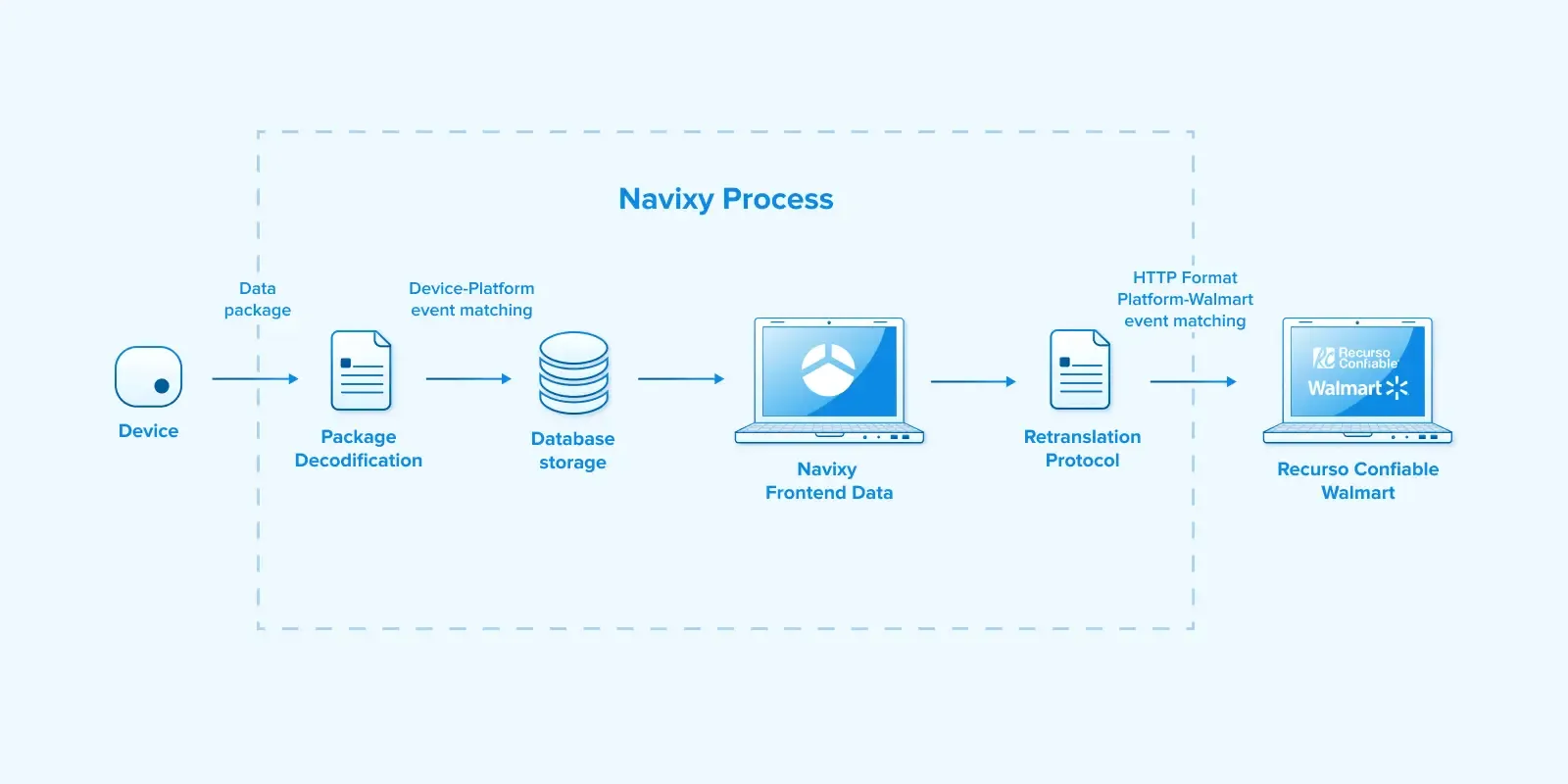
As for connectivity, once Navixy receives the data from the device, it is sent to RC without delay or batch time. So, the retranslation is immediate, which fully supports Walmart’s requirement for consistent data transmission.
The results. Scaling the solution across Mexico’s logistics ecosystem
By updating the Recurso Confiable configuration to match Walmart México’s specific event codes, Tesatel created a flexible integration model that can be easily adapted for other carriers looking to meet similar retailer requirements. What began as a simple configuration adjustment has evolved into a repeatable blueprint for achieving RC compliance in large-scale retail operations.
The solution proved stable and efficient in production, passing Walmart’s validation checks and maintaining consistent data transmission under operational load. More importantly, it gave Tesatel’s engineering team a configuration framework they can now reuse for other enterprise clients that require RC adaptations, reducing deployment time and integration costs.
Due to its infrastructure and equipment, Navixy has been an important ally in meeting specific requirements, thanks to its openness and flexibility in its tracking system.
— J. Pablo Arriaga, Project Solutions Director in Tesatel
This success reflects why many companies integrating Navixy into their business models report strong growth and efficiency gains. The combination of technical excellence, robust architecture, and industry-specific flexibility has helped Navixy partners achieve measurable results — often reaching 35-50% revenue growth and 15-25% margin improvements within the first two years of adoption.
For the Tesatel’s customer, the outcome was immediate: successful onboarding to Walmart México’s logistics network and recognition as a verified transport partner. For Tesatel, it was a scalable advantage. And for Navixy, it demonstrated how a well-designed technology platform can transform compliance requirements into lasting business opportunities across Mexico’s logistics ecosystem.
Improving the result. IoT Logic for time difference monitoring
Navixy is committed to providing our customers with all the monitoring tools they need to add value to their own clients. Thanks to Tesatel’s customer’s case we now can offer a solution that can be scaled across fleets in Mexico. But we also thought about making it even better and more effective, making the most of Navixy’s functionality, particularly, IoT Logic.
Now, for context, IoT Logic is Navixy’s automation tool for building data pipelines that process information from GPS and IoT devices. It enables data transformations, complex calculations, conditional logic, and automated device actions when specific conditions are met — from health checks and maintenance scheduling to safety measures and the monitoring of specific, custom parameters.
Back to the case, how could IoT Logic support the customer in that process? Well, it might seem that automation and trusted resources are two separate topics. But taking into account the strict requirements to consistent data transmission we mentioned earlier, you see that IoT Logic can make perfect sense here. Actually, fleet operators can leverage data flows that alert monitoring teams when a device loses satellite signal or when there’s an undesirable delay within the fleet’s activity, allowing them to timely react and, in some cases, even fix issues automatically.
The following IoT Logic workflow illustrates this approach.
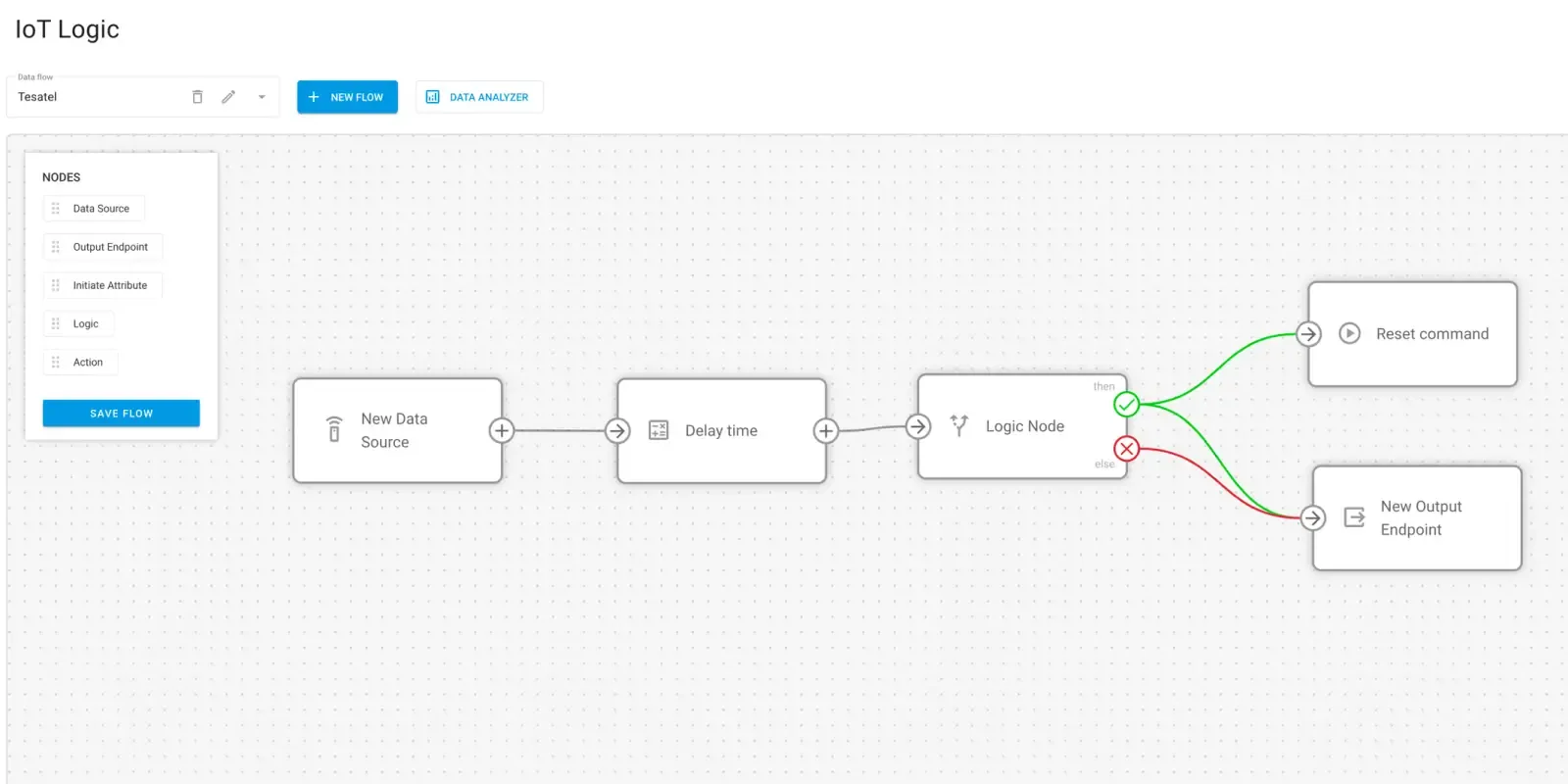
The created attribute should represent the difference between a constant variable — in this case, the satellite parameter, which is essential to determine whether the unit is transmitting valid data or not. For this reason, the system will calculate the difference between the server time and the timestamp generated by the device.
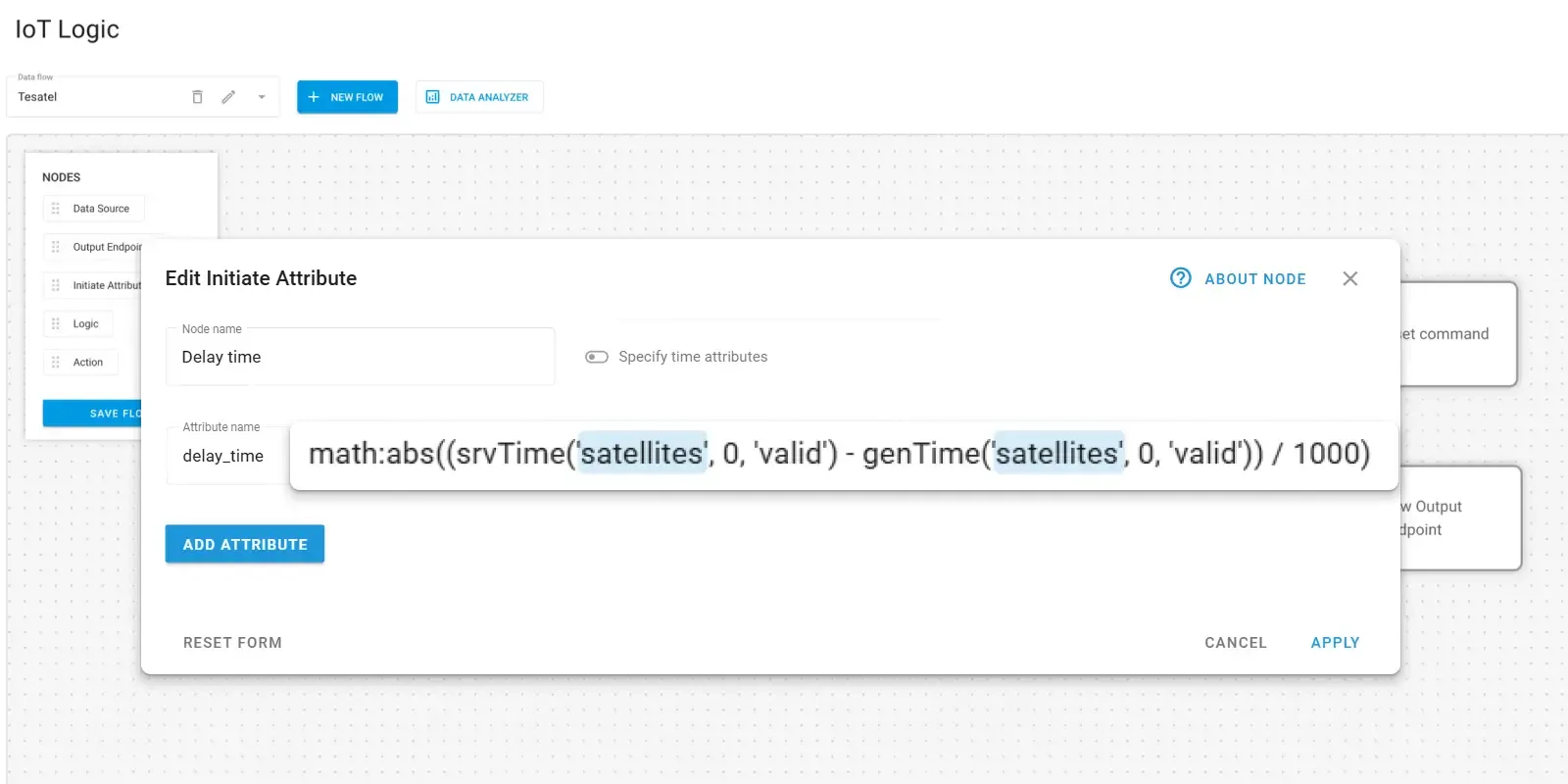
Subsequently, the data will connect to the logical node, where we’ll analyze the necessary conditions based on the satellite status or difference between server and device timestamp. These indicators reveal the overall health of the device, allowing us to trigger a monitoring alert and the reset command through the action node whenever one of these predefined conditions is met.
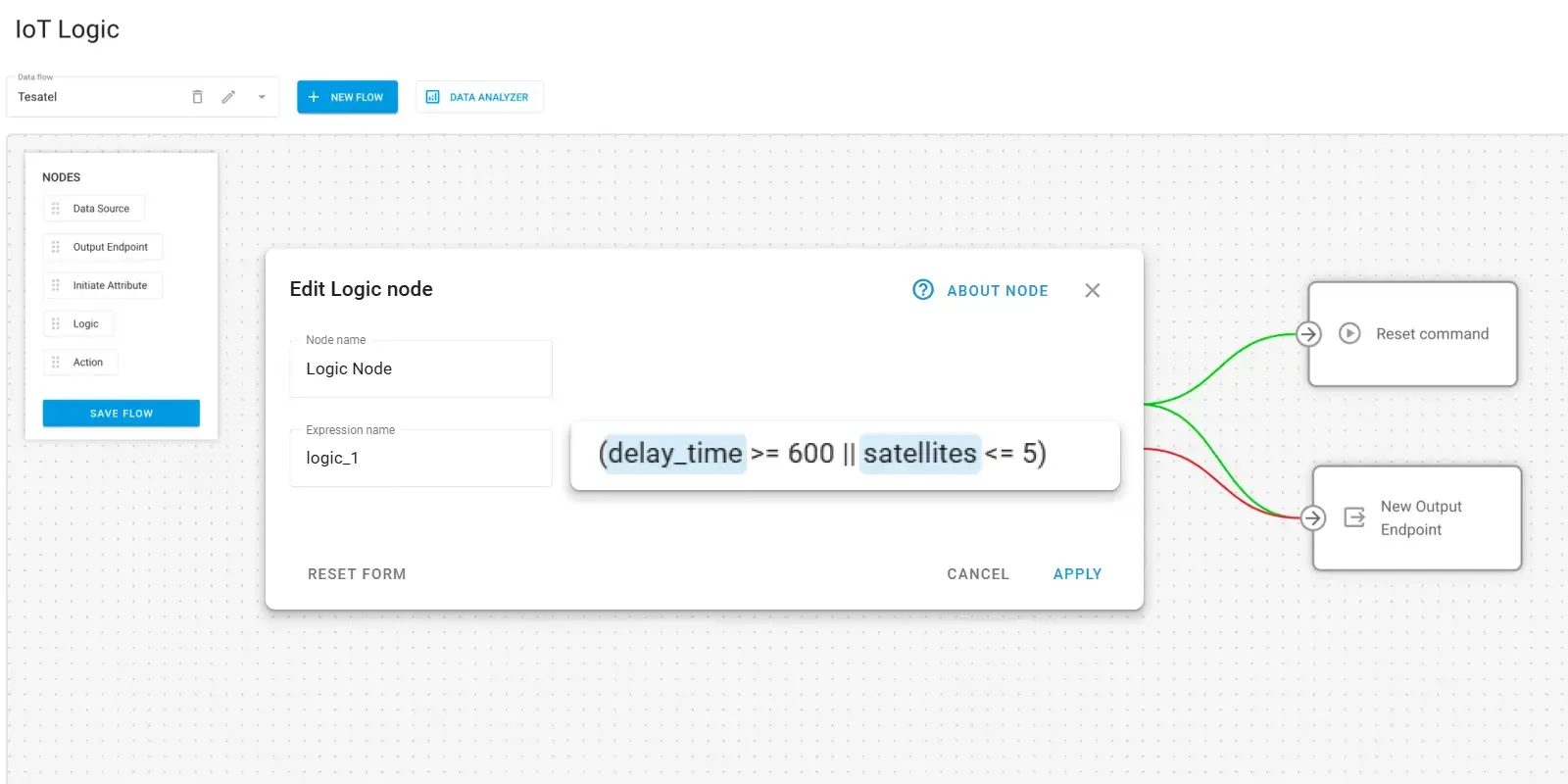
This data flow not only provides an alert for a potential loss of connection but also serves as a preventive measure. It enables proactive actions such as initiating an investigation, documenting incidents, or recording events that help the team stay prepared in case Walmart decides to conduct an audit due to missing data during a specific time period.
Turning Recurso Confiable compliance into opportunity in Mexico’s logistics market
This project showed how Recurso Confiable compliance, often seen as a technical requirement, can also drive business growth. What began as a configuration update for a single carrier evolved into a flexible framework that other logistics providers in Mexico can now use to meet retailer-specific RC standards, including those required by Walmart México.
By helping Tesatel implement these adjustments efficiently, Navixy demonstrated how a technology partner can simplify complex compliance processes without adding infrastructure or disrupting operations. The collaboration also highlighted how practical technical expertise and responsive support can turn mandatory updates into strategic advantages.
Since Recurso Confiable is already a de facto requirement for carriers that wish to work with major retailers in Mexico, logistics companies need systems that can adapt quickly to evolving data and validation rules. Navixy continues to help its partners meet these demands through flexible, configurable solutions that connect compliance with performance. By supporting companies like Tesatel, Navixy shows how the right technology can transform compliance into an opportunity for growth and long-term partnership across Mexico’s logistics ecosystem.
Planning to become Walmart México’s logistics partner? Contact Sales, and we’ll help you set up Recurso Confiable data retransmission in full compliance with Walmart México’s requirements.
On this page