Integrated telematics for Europe’s e-mobility boom: Meeting rising demands for smarter data, diagnostics, and fleet tracking

AuthorKonstantin S., Head of Navixy UK
E-mobility is moving fast — and not just on the roads. As fleets shift to electric, companies face new challenges that standard telematics can’t always solve. From compact e-bikes to high-voltage machinery, the industry needs smarter, more tailored solutions.
At Navixy, we stay close to these trends to help our customers adapt and grow with the right technology. We’ve recently expanded our ecosystem with Teltonika’s FTC305—and its variant, FTM305—purpose-built devices for electric mobility that, together with our platform, deliver the data, diagnostics, and control this industry demands. Here’s how it makes a difference.
E-mobility market growth: More than just EVs
The e-mobility market across the UK and EU is a rapidly evolving reality, transforming urban logistics, last-mile delivery, shared mobility, and even warehouse operations.
According to various sources, the European e-bike market is estimated to reach over $45 billion by 2032, growing at up to 14.6% annually (Compound Annual Growth Rate, or CAGR, a standard measure for compounded yearly market growth). Meanwhile, commercial fleet electrification and EV fleet management systems are expected to double or triple in value over the next decade, driven by low-emission zones, government incentives, and corporate sustainability mandates.
These figures reflect the ongoing explosion of demand for micro-mobility solutions across urban and suburban environments. For businesses and manufacturers operating in this space, telematics is becoming the key to unlocking greater efficiency, visibility, and value.
E-mobility needs smarter tracking: Introducing Teltonika FTC305 and FTM305
To meet the growing demands of the e-mobility sector, Navixy has partnered with Teltonika to support two EV-optimized trackers:
- The FTC305, designed for LTE Cat 1 networks
- The FTM305, a variant for LTE Cat M1 designed for North America
These trackers go beyond basic GPS tracking, offering deep integration capabilities across voltage systems, vehicle types, and installation scenarios. Key features include:
- CAN bus access and digital I/O support for live data on battery health, motor performance, and energy systems, critical for e-mobility use cases
- Advanced features like Green Driving, towing alerts, jamming detection, and configurable input/output monitoring
- Network flexibility. FTC305 supports LTE Cat 1 for stable, wide-area communication; FTM305 provides LTE Cat M1 connectivity for low-power, IoT-oriented deployments
- 10–97 V power range, suitable for small EVs and industrial machines
- IP67-rated casing for reliability in dusty, wet, or high-vibration environments
- No-casing variant with external antenna and extended battery life, ideal for OEM integration directly into e-bike frames during production
Why smarter tracking matters in e-mobility
Electric vehicles come with different needs than their gas-powered predecessors — and legacy tracking systems often fall short. Here’s why smarter tracking is essential:
1. Power systems vary — a lot
EVs operate across a wide range of voltages, from 10 V in small scooters to nearly 100 V in industrial equipment. Most traditional GPS trackers are built for 12/24 V systems and can’t handle higher voltages or fluctuating loads. This mismatch often results in device failure or limited compatibility across a fleet.
2. Battery health is everything
Batteries are the single most expensive and failure-prone component in EVs. Their condition directly affects performance, uptime, and safety. Without CAN-level visibility into battery status, temperature, and charge cycles, operators risk sudden breakdowns, shorter battery life, and increased operating costs.
3. EV fleets are anything but uniform
Fleet managers often deal with mixed assets: e-cargo bikes, converted utility carts, or factory-integrated EVs from different vendors. These vehicles vary widely in size, design, and electronics. A flexible tracker — one that can be embedded into frames or mounted externally — is needed to support both OEM integration and aftermarket installs.
4. Environments aren’t always friendly
Many EVs operate in tough conditions: forklifts in dusty warehouses, delivery scooters exposed to rain, or service vehicles facing vibration and debris. Trackers with low ingress protection ratings fail quickly in these settings. IP67-rated enclosures, like in the FTC305, are necessary for long-term reliability.
5. Unpredictable city networks and limited satellite visibility
Urban environments present real signal challenges: GPS shadowing from buildings, dropped signals in underground parking, or inconsistent cellular coverage. Devices must be able to maintain communication and positional accuracy in these conditions. LTE Cat 1 offers better resilience for mobile use than 2G/3G or NB-IoT.
What is more, FTC305/FTM305 belong to the latest generation of Teltonika solutions for telematics, FT platform devices. Its GNSS module can connect to up to 41 visible satellites simultaneously, providing a more accurate track and addressing the issue of urban canyons.
6. Compliance and reporting are now part of the job
Many cities and regulators now require detailed reporting on EV fleet operations — including energy usage, mileage, and service intervals. Without automated data from the vehicle's systems, gathering this information is time-consuming and prone to error. A smart tracker with CAN integration turns raw data into usable reports.
At this point, the FTC305 and FTM305, in pair with Navixy, can help fleet operators and manufacturers stay ahead by knowing where vehicles are and understanding how they’re performing. It enables real-time diagnostics, supports preventive maintenance, and ensures that vehicles are kept in service and compliant with evolving standards.
The complete solution: Navixy + FTC305/FTM305 integration
The essence of the Navixy and FTC305 and FTM305 integration lies in the synergy between robust hardware and intelligent software. Teltonika’s devices deliver raw, real-time insights directly from electric vehicles, across voltage systems, environments, and usage types. But data alone isn’t enough.
Navixy complements this with a scalable, flexible telematics platform that transforms raw data into actionable intelligence. This combination enables a truly complete solution: one that supports diagnostics, automation, analytics, compliance, and new revenue streams across the e-mobility value chain.
Together, they empower OEMs, fleet operators, and service providers to not only monitor vehicles, but to understand them, optimize them, and build connected services that scale.
Going beyond GPS: Smart portlets and automation with FTC305/FTM305
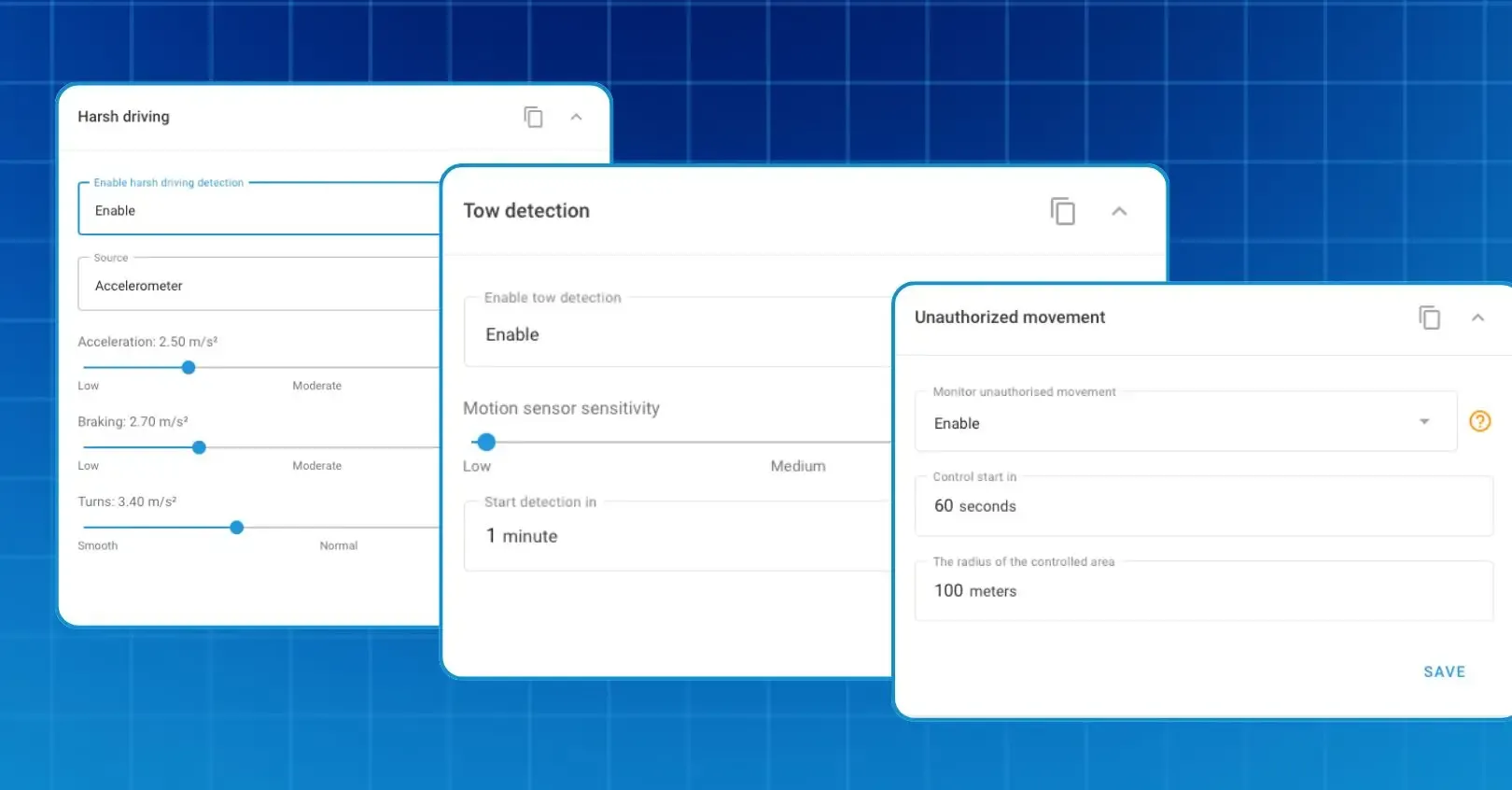
Navixy’s integration with FTC305 and FTM305 unlocks a suite of powerful interactive portlets that help operators visualize, manage, and protect their EV fleets in real time:
Configure unauthorized movement and tow detection alerts to respond to vibration, unauthorized startup, or abnormal motion
Fine-tune harsh driving monitoring with separate thresholds for acceleration, braking, and cornering—customized by vehicle type or usage case
Automate actions with IoT Logic, Navixy’s built-in rules engine that connects CAN signals, digital inputs, and motion events to alerts, workflows, or dashboards
What the integration delivers
The combination of Teltonika’s EV-optimized hardware with Navixy’s intelligent platform delivers meaningful business outcomes:
- Enable proactive health monitoring using CAN-level diagnostics and custom health scores, with automated maintenance triggers via IoT Logic
- Optimize energy use by analyzing real-world battery behavior and usage patterns
- Gain operational visibility through configurable reports, geo-analytics, and usage benchmarking across vehicle types or regions
- Deploy factory-ready integration with Teltonika’s no-casing variant, installable during manufacturing without altering frame design
- Automate regulatory compliance with LEZ access reports, energy logs, and service documentation generated from CAN and GPS data
As you can see, this integration goes beyond compatibility, helping build connected mobility products that are smarter, more efficient, and commercially viable from day one.
New business opportunities enabled
Beyond operational benefits, the Navixy + FTC305 integration opens entirely new revenue streams for e-mobility businesses by transforming physical products into connected, monetizable digital assets.
🛠️ Digital twin at the factory: Enabling a connected e-bike
The no-casing version of FTC305, designed for seamless factory installation, empowers manufacturers to embed telematics right into the e-bike frame — before the product even leaves the warehouse.
Use case: A manufacturer installs FTC305 inside each e-bike during production. As a result, the bike leaves the factory not just as a physical product — but as a connected digital asset.
This creates a "Digital Instance" of the bike on the Navixy platform, with:
- Pre-configured tracking
- Secure cloud connectivity
- Device already mapped to the VIN/serial number
Now, the bike becomes more than a vehicle — it's an IoT-powered product ready to support smart services from day one.
💰 Monetizing telematics in the B2C market
According to market trends, connected services can boost aftermarket revenue significantly — and the Navixy + Teltonika stack makes this achievable out-of-the-box.
Use case: The end user receives a free telemetry and location service bundled with the bike — for example, valid during the warranty period.
After that, the user is offered a paid subscription via the brand's app or portal, unlocking:
- Real-time location tracking
- Movement alerts for anti-theft
- Geo-fencing and trip history
- Smart warranty validation (e.g., misuse, overuse)
This opens up recurring revenue per unit — while increasing perceived product value and customer retention.
🤝 Scaling through dealerships and leasing
For manufacturers working with dealers, leasing companies, or B2B clients (e.g. delivery fleets, rental networks), the Navixy platform provides a robust multi-tenant environment.
Use case: A manufacturer creates sub-accounts for each of their dealership partners:
- Dealer A works with food delivery
- Dealer B leases to gig workers
- Dealer C runs corporate fleet pilots
Each sub-account has:
- Its own fleet dashboard
- Isolated access to their clients' data
- Custom alerts, reports, and branding
Meanwhile, the manufacturer retains administrative control, analytics on bike usage across all accounts, and a direct channel for OTA updates or maintenance policies.
📦 Embedded insurance and warranty automation
With CAN data and movement logs:
- Warranty claims can be verified automatically (e.g., overuse, off-road behavior)
- Usage-based insurance (UBI) becomes viable: low-mileage riders get discounts
- Theft recovery and incident reconstruction become data-driven
Who benefits and how
The Navixy + FTC305/FTM305 solution is not just a technical integration — it's a strategic enabler of new business models in the e-mobility space:
| Stakeholder | Value Gained |
|---|---|
| OEM/Manufacturer | Productized services, recurring revenue, data access |
| Dealer/Fleet | Ready-made dashboards, sub-account control |
| End User | Security, tracking, and smart ownership options |
Long story short, by combining robust hardware, advanced CAN-based telematics, and Navixy's flexible IoT platform, businesses can turn every e-bike into a smart, monetizable asset — from the factory floor to the road.
Looking ahead: The future of connected e-mobility
Multiple market research reports indicate that Europe's e-mobility sector will maintain strong double-digit growth across multiple segments over the next decade. With this growth comes increasing demand for sophisticated tracking, diagnostics, and data integration capabilities.
The combination of Teltonika's purpose-built FTC305 hardware and Navixy's flexible platform positions e-mobility businesses to succeed in this evolving landscape. Success in tomorrow's market won't just be about building better vehicles — it will be about creating smarter, more connected mobility ecosystems that deliver value through data, insights, and intelligent automation.
Whether you're launching a next-generation e-bike brand, managing a warehouse fleet of electric forklifts, or operating a shared urban mobility platform, the integrated solution provides the foundation to deploy quickly, customize deeply, and scale globally as the e-mobility revolution continues to accelerate.
Ready to bring smarter tracking to your e-mobility operations? Let’s talk about your needs and how Navixy can help.