Drunk driving prevention. Automated sobriety checks to improve driver behavior and road safety

AuthorViktor T., Field Expert, Navixy On-premise
A leading fleet monitoring provider set out to make their operations even safer by rethinking how driver sobriety checks are handled. Instead of relying on manual testing and paperwork, they introduced an automated system that connects alcohol sensors directly to their telematics platform. As a result, every trip begins with a built-in sobriety check that runs automatically before ignition, keeping everyone safe from the start.
Read on to see how Navixy’s IoT Logic made it possible, turning sobriety testing data into smart decisions that help fleets prevent risks before they happen.
Key takeaways
- Navixy automated driver sobriety checks for a major regional fleet monitoring provider.
- IoT Logic played a key role, powering the logic that checks alcohol levels and controls engine access automatically.
- Using alcohol sensor readings connected to a GPS device, the system blocks ignition if intoxication is detected.
- The project proved that IoT-driven automation can both improve safety and build driver trust.
Want to automate telematics-based operations for you or your clients? Book a demo to learn more how to do it with IoT Logic.
Why is sobriety testing crucial, or how drunk driving affects road safety
Every year, thousands of lives are lost on roads worldwide because of drunk driving. According to the World Health Organization, up to 30% of all fatal traffic accidents are alcohol-related. These figures go far beyond statistics, as they show the real risks irresponsible driver behavior poses to people on the road and to the business itself.
How to ensure driver responsibility, protect lives and operations? That’s the ongoing challenge logistics providers face, and it’s one technology can now address.
A quick look back. For a long time telematics technology could only react to incidents after they happened, tracking routes and recording data but unable to prevent dangerous situations in real time. Today, it's a totally different story. Telematics has become an active safety tool that can spot danger early and act on it (for example, stopping a vehicle before it moves if it detects a drunk driving attempt).
Why manual sobriety checks might not work for improving driver discipline
Let’s be honest, safe driving starts long before the engine turns on. Every driver’s habit, attitude, and sense of responsibility play a big role in road safety. For fleet operators, building a culture of discipline behind the wheel is just as important as maintaining the vehicles themselves.
With driver sobriety being one of the main aspects of discipline and responsibility, it’s surprising how often it still depends on manual sobriety checks and paper logs. This approach has some clear weaknesses, including inconsistent and random testing practices, inaccurate or incomplete results, and a high risk of human error, bias, or even intentional manipulation.
And overall, manual procedures are time-consuming and hard to scale as fleets grow.
The consequences can be severe. Beyond the risk to human lives, companies also face fines, damage to their reputation, and operational delays. In areas where alcohol-related driving incidents are common, the stakes are high, and customers expect monitoring providers to deliver real safety solutions.
Customer case. Automating driver sobriety checks to improve driver behavior
A major fleet monitoring provider in the region, serving fleets that range from long-haul trucks to passenger buses, approached Navixy with a challenge their customers face every day. How to surely prevent drunk driving?
Existing processes depended on manual sobriety testing, which made them slow and inconsistent. At this point, the company needed an automated system that could perform mandatory sobriety checks quickly, eliminate human error, and keep every trip safe from the start.
Solution. Using Navixy’s IoT Logic to automate pre-driving sobriety checks
Navixy helped the customer implement an automated alcohol testing system powered by IoT Logic, completely changing how they managed driver safety. Drivers now take a quick breath test before starting the engine. The connected alcohol sensor sends the data through the GPS tracker to the Navixy platform, where IoT Logic instantly checks the result.
If the alcohol level is within the safe range, the system unlocks the ignition and allows the trip to begin. If it exceeds the set threshold, the vehicle remains blocked, preventing drunk driving before it starts. This automatic process improves safety across the fleet without delays, errors, or constant supervision.
For the monitoring provider, the solution drastically simplified daily operations, removed paperwork, and gave them a strong competitive advantage. They can now control driver sobriety automatically, deliver consistent safety standards, and strengthen their reputation among customers who value reliable and responsible fleet management.
Inside the technology that makes automated sobriety checks possible
This solution works because the hardware and software are fully in sync. The alcohol sensor connects to the GPS tracker, and Navixy’s IoT Logic instantly processes the data, turning each breath test into an automatic safety response. Let’s look more closely at how it works.
Step #1. Driver breathes into the alcohol sensor
Each driver must blow into a connected analog alcohol sensor before starting the vehicle. This ensures that every trip begins with a verified sobriety check.
Step #2. Tracker sends analog data to the Navixy platform
The alcohol sensor measures the alcohol concentration in a driver’s breath and sends the signal to the connected GPS tracker, which then transmits the analog value directly to the Navixy platform.
Step #3. IoT Logic flow processes the received data
On the Navixy platform, a configured IoT Logic flow evaluates the incoming analog value against predefined thresholds:
- Below 782 – no breath detected
- Between 782 and 3172 – breath detected, no alcohol
- Above 3172 – driver is over the alcohol limit
Now, what do these numbers mean exactly? They come from how the sensor reacts when someone blows into it. The sensor responds to airflow strength and any alcohol traces in that air. This reaction turns into a signal that the tracker shows as a number. The initial thresholds come from lab tests by the manufacturer that map how the sensor behaves at different airflow levels and different alcohol concentrations. These limits can be adjusted later by integrators or fleet operators if local rules or safety policies require it.
A reading below 782 means the airflow was too weak to activate the sensor, which can happen if the driver did not blow, blew too softly, or tried to avoid giving a proper sample. Once the airflow is strong enough, the sensor begins detecting alcohol. Readings between 782 and 3172 show proper airflow with no alcohol or concentration within allowed limit. Values above 3172 mean the sensor reacted more strongly, which signals alcohol in the breath at an unsafe level.
Step #4. Automated actions triggered
If the vehicle ignition is not detected, the system initiates a further logic flow to block or unlock the engine based on logical conditions.
If the vehicle ignition is detected, the system does not perform any actions to avoid interfering with the operation of the running vehicle.
If the driver’s breath is not detected (<782), the system switches the device output on, thus blocking the engine and activating the immobilizer to prevent the vehicle from starting.
If the driver is sober (782–3172), the system unlocks the ignition, the device output stays off, and the vehicle can start safely.
If the driver is intoxicated (>3172), the system immediately blocks the engine, switches the device output on, and activates the immobilizer to prevent the vehicle from starting.
Condition-based automation: the core element in the sobriety testing solution
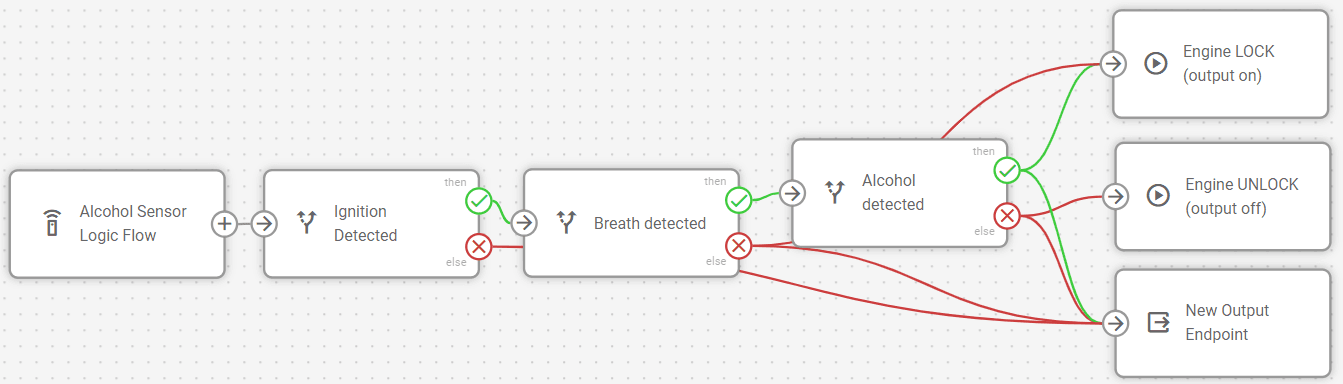
Navixy plays a key part in this process. While the tracker receives data from the sensor and controls the immobilizer, it can’t determine whether alcohol intoxication has occurred. Navixy takes the role of decision maker, processing data and triggering automated actions in real time.
It also lets managers fine-tune threshold values, explicitly allowing or blocking driving when a small amount of alcohol is detected (for example, after consuming low-alcohol beverages), depending on what’s allowed by law and local regulations.
Put together, with IoT Logic, users can:
- Flexibly set and adjust threshold values
- Apply the same logic flow to multiple devices in just a few clicks
- Avoid constant hardware reconfiguration or the need for costly, advanced devices, since all calculations happen on the platform side
More road safety provisions beyond simple logic
In the case described here, the logic is simple and, basically, boils down to reading the value and performing an action. However, IoT Logic is powerful enough to handle much more complex workflows by combining multiple parameters. You can supplement the logical flow and add new logical nodes to ensure even greater safety for road transport. Let’s look at some examples below.
Driver identification based on a hardware key
A hardware key is a physical device with a unique ID or cryptographic chip that authenticates a driver by proving their identity to the vehicle or system. If the driver’s key isn’t recognized or isn’t on the list of authorized keys, IoT Logic blocks the engine even if the driver is sober.
Multiple breath attempts
You can configure the system to allow multiple breath attempts, letting drivers retake the test if the first breath sample was accidental, incomplete, or too weak to provide an accurate reading. This way, the device still gets an accurate result even if the first try wasn’t clear or strong enough.
Ignition timing or shift rules
You can implement ignition timing or shift rules to include schedule compliance, preventing the vehicle from being used outside designated working hours. This way, drivers can use the vehicle only during approved hours, keeping trips on schedule and helping them stick to proper rest times. In practice, it might include:
- Sobriety checks are only allowed at certain times, for example, 30 minutes before the start of a shift.
- If the test is conducted outside the specified time, the system sends a notification to the dispatcher.
- A restriction can be set so that if the test is not passed on time, the engine can’t be started.
- For long-distance drivers, you can configure regular checks and monitoring of rest periods to help prevent fatigue.
Multi-level thresholds
You can set not only strict values but also intermediate ones. For example, you can introduce a suspicion value for cases when the alcohol level is slightly above sober and an additional checkup may be required. In this case, you can choose not to block the engine but to send a notification to the dispatcher instead.
Notification and escalation
If the driver is found to be under the influence, the system automatically sends an SMS or email notification to the responsible manager. Depending on the setup, it can also trigger additional actions such as logging the event, alerting the dispatcher, or starting a follow-up check to confirm the result before further steps are taken.
An unobvious outcome: how automation supports a safety-first culture
It’s worth noting that the success of any driver behavior measures largely depends on how drivers perceive them. How can automation help here?
A quick note to clear the air — are sobriety checks legal? Yes. They are a common and accepted practice in commercial fleets across many regions. Their purpose is not to invade privacy but to protect drivers and the public. What might make them seem controversial is the human factor. When checks are done manually, there’s room for doubt, inconsistency, or perceived bias. Automation removes that uncertainty. Every check follows the same rule, leaving no space for speculation or personal interpretation.
This fairness is what makes automated sobriety testing effective. Drivers see it not as punishment but as protection for themselves and others. Because automation handles the checks and evaluates data objectively in real time, everyone is treated equally and with respect.
Training also plays an important role. When teams understand how the system works and why it matters, they’re more likely to trust it and use it correctly. Regular maintenance matters too. Calibrated alcotesters and accuracy checks keep the process reliable and ensure that automation remains a trusted part of daily operations.
The future of safer roads with IoT-based fleet safety solutions
The success of automated sobriety checks shows what is possible when technology and responsibility move in the same direction. IoT-based safety tools like Navixy’s IoT Logic go beyond single tasks. They not only detect risks but help prevent them, expanding into areas such as fatigue detection, distraction monitoring, and other measures that stop incidents before they happen.
This case proves that technology does not replace human judgment. It strengthens it. By giving drivers and managers real-time insights and automatic safeguards, fleets can protect both people and business interests while building a stronger safety culture.
The path forward is clear. Each new step toward automation makes roads safer for everyone. Fleet operators who adopt IoT-based monitoring today are not only improving compliance but also helping prevent tragedies before they happen.
Do you believe this solution can help your business? Contact Sales and let’s discuss how we can apply it to your particular case.
On this page
- Why is sobriety testing crucial, or how drunk driving affects road safety
- Customer case. Automating driver sobriety checks to improve driver behavior
- Inside the technology that makes automated sobriety checks possible
- An unobvious outcome: how automation supports a safety-first culture
- The future of safer roads with IoT-based fleet safety solutions