Composable Telematics: Why the Future of Fleet Infrastructure Is Modular

You've seen this pattern before: a Telematics Service Provider (TSP) invests months configuring a vendor's platform, training their team on its workflows, and migrating customer data into its ecosystem. Then a new vertical opportunity emerges — construction fleets, cold chain logistics, rental equipment — and the platform can't adapt. Not without expensive custom development. Not without waiting on the vendor's roadmap. Not without compromises that erode the differentiation you were building in the first place.
This is the monolith problem, and it's been telematics' default architecture for twenty years.
The monolith worked — until it didn't
When telematics meant "dots on a map," monolithic platforms made sense. One vendor controlled the stack: devices, data, dashboards, and business logic. TSPs resold access, competed on price and local service, and accepted the constraints as the cost of doing business.
But the market has shifted. Every TSP's customers now want something different — custom alerts, vertical-specific workflows, integrations with their ERP or dispatch systems, analytics that match how their operations actually run. The monolithic response? Configure what you can. Request what you can't. Wait.
Meanwhile, your competitors using the same platform face identical constraints. Differentiation becomes a matter of sales and service, not product. Margins compress. Churn increases when customers realize they can get the same software from three other providers in your region.
What is composable telematics?
Composable telematics is infrastructure assembled from independent, interchangeable components — each powerful on its own, transformative when combined.
The term describes how modular architecture enables organizations to adapt faster than those locked into rigid systems. Applied to telematics, it means TSPs shift from "buying a finished product" to "composing exactly what each customer needs."
This isn't just rebranding "flexible" or "customizable." True composability requires that each component operates independently, exposes programmatic interfaces, and can be replaced or extended without breaking the whole. It's the difference between a modular synthesizer and a preset keyboard — both make sound, but only one lets you create something no one else can.
For TSPs specifically, composable architecture matters more than it does for direct fleet operators. A single fleet has one set of requirements. A TSP serves dozens or hundreds of customers, each with different verticals, regions, and operational patterns. The ability to compose tailored solutions from reusable building blocks determines whether you can profitably serve that diversity or turn away opportunities.
The three pillars of composable telematics
Composable telematics rests on three functional layers, each addressing a distinct concern. Together, they form the stack that TSPs use to build differentiated offerings.
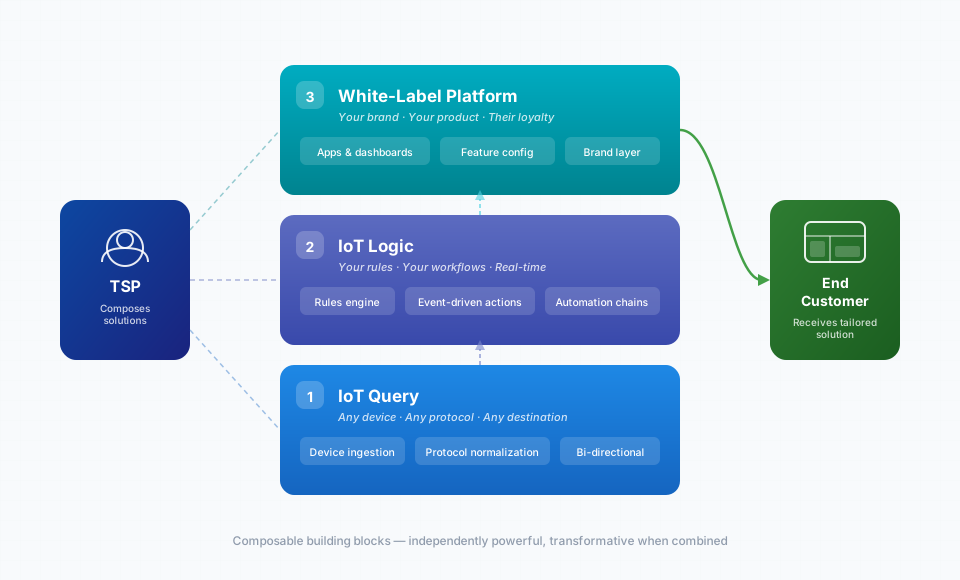
Pillar 1: IoT Query — Composable data
Any device. Any protocol. Any destination.
IoT Query is the data ingestion layer. It handles the messy reality of telematics hardware: hundreds of device manufacturers, proprietary protocols, varying data formats, and the need to normalize everything into a consistent, queryable structure.
For TSPs, this pillar answers a critical question: which devices can I support? In monolithic platforms, the answer depends on the vendor's integration roadmap. In composable architecture, protocol-agnostic ingestion means you connect the devices your market needs — whether that's a mainstream GPS tracker, an OBD-II dongle, a BLE temperature sensor, or an industrial IoT gateway.
Composable data also means bidirectional capability. You're not just collecting location and sensor readings; you're sending commands back to devices. Lock a vehicle. Trigger an output. Update firmware. The data layer becomes a command layer.
What makes this composable rather than just "compatible"? The normalized data stream. Regardless of which device sends the signal, the output conforms to a consistent schema that downstream components can consume. Swap devices without rewriting business logic.
Pillar 2: IoT Logic — Composable automation
Your rules. Your workflows. Real-time.
IoT Logic is the decision layer. It transforms raw data into operational intelligence through rules, alerts, and automation chains configured by business users — not developers.
Monolithic platforms offer pre-built automation templates: geofence alerts, speeding notifications, maintenance reminders. These work for common use cases but break down when customers need something specific. "Alert me when a refrigerated trailer drops below -18°C for more than fifteen minutes while inside a distribution center geofence" isn't a template — it's a composed rule.
Composable automation differs from templates in three ways. First, rules chain together. The output of one rule becomes the input to another, enabling complex workflows from simple components. Second, rules are event-driven and real-time, not batch-processed. When conditions match, actions fire immediately. Third, the logic belongs to the TSP. You build rules that match your customers' operations, package them into your offering, and update them without waiting on a vendor release.
For TSPs, composable automation is where differentiation lives. Two providers might offer the same devices and dashboards, but the one with smarter, customer-specific automation delivers more value — and commands higher margins.
Pillar 3: White-Label Platform — Composable experience
Your brand. Your product. Their loyalty.
The White-Label Platform is the presentation layer — the apps, dashboards, and reports your customers actually see. In composable architecture, this layer is fully yours.
"White-label" in telematics often means logo swapping: your brand on someone else's interface. Composable white-labeling goes further. You control which features appear for each customer tier. You configure dashboards for vertical-specific KPIs. You customize the mobile app experience. The underlying infrastructure disappears behind your product.
Full brand ownership means your customers build loyalty to you, not your platform vendor. When renewal time comes, they're evaluating your service — not comparison shopping for identical software from your competitors.
For TSPs pursuing vertical specialization, composable experience is essential. A construction fleet offering looks different from a cold chain solution. A rental equipment platform has different workflows than a municipal vehicle tracker. With composable presentation, you ship these variants without maintaining separate codebases.
Composable vs. monolithic vs. DIY: The tradeoffs
TSPs evaluating telematics architecture face three paths. Each has legitimate use cases — and honest limitations.
Monolithic platforms get you to market fast. The stack is integrated, documentation is mature, and implementation follows a known playbook. You'll look like everyone else using that platform, but if you compete on price, local service, or relationship — not product differentiation — that may be acceptable. The tradeoff: your ceiling is their roadmap. Features they don't prioritize, you don't get.
DIY / raw platform approaches give you complete control. You select each component, build the integrations, and own every line of code. If you have strong engineering resources, unique requirements that no platform addresses, and a timeline measured in years rather than months, this can work. The tradeoff: you're now a software company. Every integration, every device protocol, every scaling challenge is yours to solve and maintain.
Composable architecture offers a middle path: faster than DIY, more flexible than monolithic. You get building blocks that have already solved the hard problems — device protocols, data normalization, real-time event processing — but you compose them into configurations that match your market. The tradeoff: there's a learning curve. Understanding how the components connect, which configurations serve which use cases, and how to package offerings for your customers requires investment.
The honest question for TSPs: where do you want to spend your engineering time? Building device protocol integrations you'll never sell directly? Or composing solutions that differentiate your business?
What composable telematics means for TSPs
Translating architecture into business outcomes, composable telematics addresses four challenges TSPs face daily.
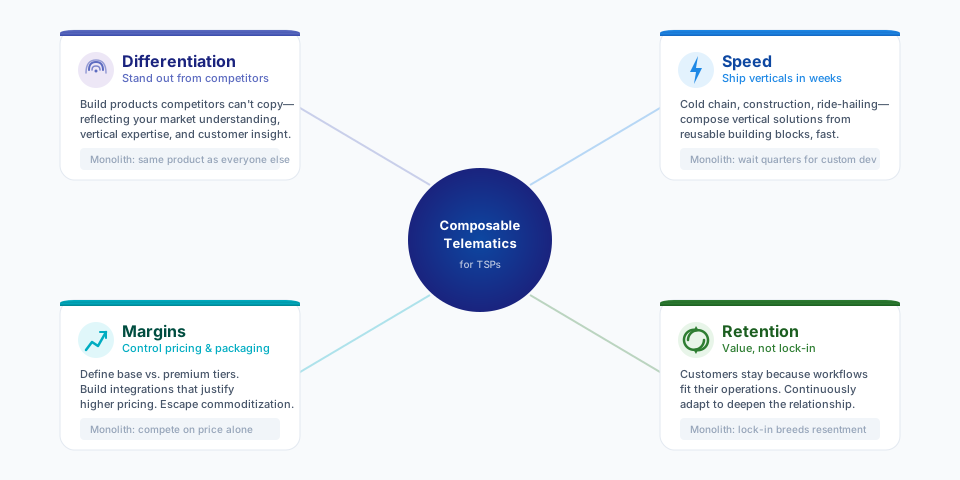
Differentiation: When you use the same monolithic platform as your competitors, you compete on price and service — not product. Composable architecture lets you build a product your competitors can't copy because it reflects your specific market understanding, vertical expertise, and customer relationships.
Speed: Vertical specialization without custom development. A cold chain offering. A construction equipment package. A ride-hailing solution. Each requires different features, alerts, dashboards, and integrations. Composable components let you ship these variants in weeks, not quarters.
Margins: You control your cost structure and pricing flexibility. Decide what's included in base packages versus premium tiers. Build integrations that justify higher pricing. Avoid the commoditization that comes from selling identical software at different price points.
Retention: Customers stay because your workflows fit their operations — not because migration would be painful. That's a crucial distinction. Lock-in creates resentment; value creates loyalty. Composable architecture lets you continuously adapt to customer needs, deepening the relationship rather than relying on switching costs.
Getting started with composable telematics
If this architecture resonates, here's a practical starting point.
Evaluate your current constraints. Where does your existing platform limit you? Which customer requests have you declined because they didn't fit the available configuration? Which verticals have you avoided because the implementation cost didn't justify the opportunity?
Identify your differentiation opportunity. What would you build if you could? Not "everything" — specific capabilities that match market gaps you understand. Maybe it's a vertical you know well but can't serve profitably. Maybe it's an integration your largest prospects keep asking for.
Assess your composition readiness. Composable architecture requires some technical capability — not deep engineering, but comfort with APIs, webhooks, and configuration-based customization. Do you have this in-house, or would you need to develop it?
Start with one pillar. You don't have to migrate everything at once. If device flexibility is your biggest constraint, explore IoT Query first. If automation is limiting your differentiation, focus on IoT Logic. If brand ownership matters most, begin with the white-label platform layer.
Navixy's platform embodies composable telematics architecture — three pillars that work independently and together, designed for TSPs building differentiated offerings. Explore the white-label capabilities, review the integration options, or dig into the API documentation to see how the components connect.
The future of fleet infrastructure isn't one vendor's vision imposed on every TSP. It's composable solutions, assembled by providers who understand their markets, for customers who need more than dots on a map.