Build your own fleet analytics app: Navixy open sources Dashboard Studio

AuthorKirill E., Navixy Data Analyst
There is a familiar moment in almost every enterprise telematics project. The data is there, the tracking works, integrations are in place. Then the client asks a simple question: “Can this dashboard look and work like our own fleet analytics application? Can we adapt it to match our UI/UX?" Read the full story to get the answer for system integrators.
Key takeaways
- Reduce delivery time by reusing a production-ready analytics UI instead of building dashboards from scratch.
- Lower integration complexity by visualizing IoT Query data directly, without adding external BI platforms.
- Simplify connectivity with the Navixy platform via seamless authentication through App Connect.
We know that for developers and vibe coders, building analytics is not the problem. Shipping it is. Built-in dashboards limit customization, while rebuilding analytics on top of external BI stacks is slow, expensive, and hard to scale once every customer wants something different.
System integrators have lived with this trade-off for years: accept rigid dashboards or own the full analytics stack. Both options hurt margins and delay delivery. Navixy is opening a third path.
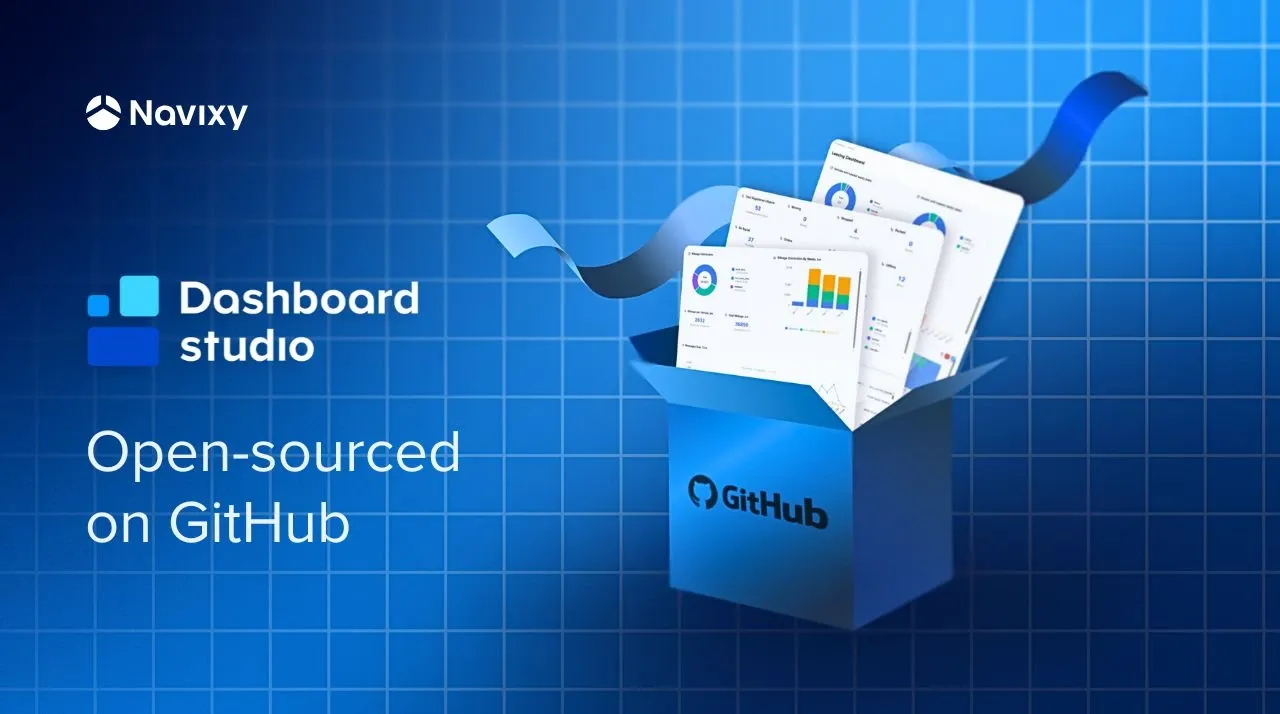
Dashboard Studio, the SQL-based dashboard builder for IoT Query, is now open source. Integrators can deploy it, modify it, and embed it directly into their own products with full control over UX.
IoT Query provides the data foundation. Dashboard Studio becomes the integrator-owned delivery layer. Customization scales, delivery accelerates, and analytics becomes a revenue stream—not a cost center.
Learn more about what opportunities Dashboard Studio opens to fleet managers in a blog post.
How to shift from fixed dashboards to flexible fleet analytics building blocks?
Dashboard Studio is the visual layer that turns IoT Query data into operational dashboards. It allows teams to build tables, charts, and KPI views, without relying on third-party BI tools for everyday analytics.
What has changed is the delivery model. Dashboard Studio is an open-source application under the MPL-2.0 license, complete with frontend and backend code, deployment instructions, and development documentation. We are sharing the analytics engine Navixy uses internally with technical teams, and let them adapt it to their own products.
Crucially, this is not a simplified or experimental version of the Navixy application. The open-source build maintains feature parity with the hosted Dashboard Studio, including the dashboard editor, visualization components, menu structure, and SQL execution logic. Updates follow the same release cycle, which reduces the risk of maintaining a frozen fork over time.
For system integrators, who partner with us, this distinction matters more than licensing. It means customization without functional compromise.
Why does this matter for integrators building their own applications?
Based on our experience, most integrators are not trying to invent analytics from scratch. They prefer to integrate analytics into something larger: a customer portal, an industry-specific operations system, or a white-label fleet application delivered under their own brand.
With access to the Dashboard Studio codebase, integrators can adapt the interface to match their design system, embed dashboards into existing navigation, and integrate authentication with their own identity layer while still relying on IoT Query as the data foundation.
We explicitly position the open-source option for these scenarios:
- white-label implementations,
- embedded analytics views,
- industry-specific workflows.
In effect, Navixy Dashboard Studio becomes a reusable fleet performance analytics module rather than a fixed product screen.
Why is IoT Query still at the center?
What does not change is the role of IoT Query itself. The open-source Dashboard Studio is still designed to work on top of IoT Query, using direct SQL access to telematics and business data.
Check our SQL Recipe Book for optimized query examples.
For integrators, this means the heavy lifting remains where it belongs. Data ingestion, normalization, security, and storage and maintenance are handled by IoT Query. Dashboard Studio focuses on visualization and interaction, and now that layer is open to modification.
The result is a cleaner separation of responsibilities. IoT Query acts as the analytical backbone, while Dashboard Studio becomes a flexible presentation layer that can be molded to fit the client’s system instead of forcing the client to adapt to a predefined UI.
How to use: as-is or turn it into part of your own product?
We are keen not to force a single deployment model. Teams that want a ready-made telematic solution can continue using Dashboard Studio as a Navixy-hosted application, integrated into the Navixy interface via Users Applications feature with Navixy App Connect. Teams that need deeper control can self-host the open-source version and embed it directly into their own fleet performance applications.
That choice is important for enterprise projects. Some customers value speed and standardization. Others demand ownership over user experience, security boundaries, and long-term roadmap decisions. Navixy now supports both approaches without splitting the ecosystem.
What to do next?
If you are building or planning a custom application on top of IoT Query, the open-source Dashboard Studio is worth a close look. It can be used out of the box, adapted incrementally, or turned into a fully embedded analytics experience inside your own system, without introducing another BI platform or rebuilding basic dashboard functionality.
Contact Sales if you want to get more details on how to get the maximum value from IoT Query and Dashboard Studio for your integration projects.
Frequently asked questions (FAQ)
Is Dashboard Studio really open-source?
Yes, we provide an open-source option for Dashboard Studio under the MPL-2.0 license.
Can I build a custom analytics app on top of it?
Yes. The open-source option is positioned for frontend customization beyond standard configuration, including custom workflows, embedded analytics views, and white-label implementations.
Can I still use Dashboard Studio without self-hosting?
Yes. We describe a Navixy-hosted option that integrates into the telematics platform interface through User Applications, using the existing session for authentication.
What do I need for authentication?
We are listing JWT tokens from Navixy App Connect as the authentication requirement for the open-source deployment.
Does the open-source version lack features compared to the hosted one?
No. The open-source version maintains feature parity with the Navixy-hosted version, including the editor, visualizations, and SQL execution layer.
On this page