> For the complete documentation index, see [llms.txt](https://navixy.com/docs/llms.txt). Markdown versions of documentation pages are available by appending `.md` to page URLs; this page is available as [Markdown](https://navixy.com/docs/user/guide/field-service/places-field-service.md).
# Places
Manage places of interest for field service: add customer sites and key locations your staff visits, and use them to streamline task assignments and routes.
**Places (or POIs)** in the **Field service** module can be used for organizing and managing key locations that your field staff need to visit, such as customer addresses, company sites, or other important points of interest. This helps streamline task assignments, optimize routes, and ensure efficient field operations.
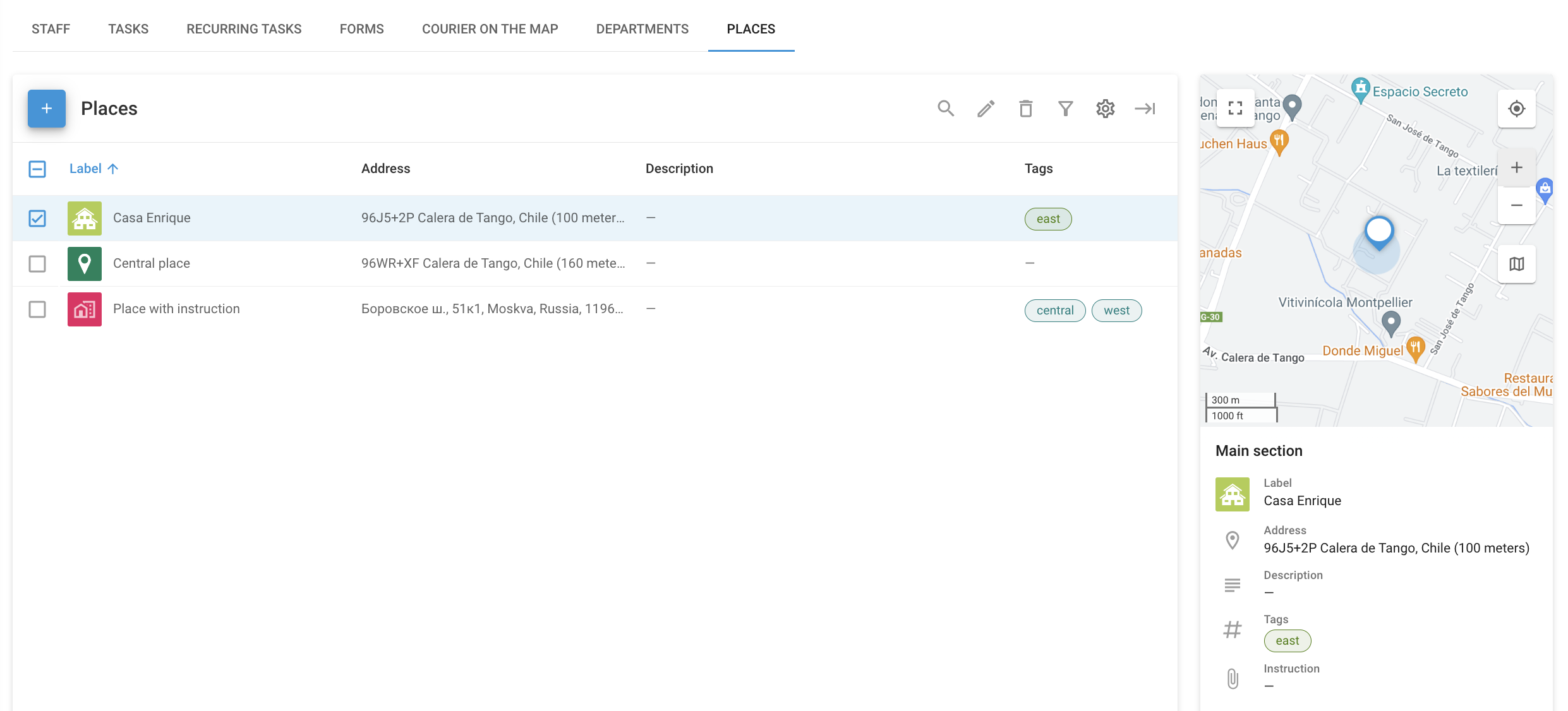
The page contains the list of all available Places along with their details, including custom fields you've added.
Places page
## How to create a Place
{% stepper %}
{% step %}
#### Go to Places
Open the **Places** page in the **Field service** module.
{% endstep %}
{% step %}
#### Start creating a Place
Click **+** to open the place creation dialogue.
{% endstep %}
{% step %}
#### Enter Place details
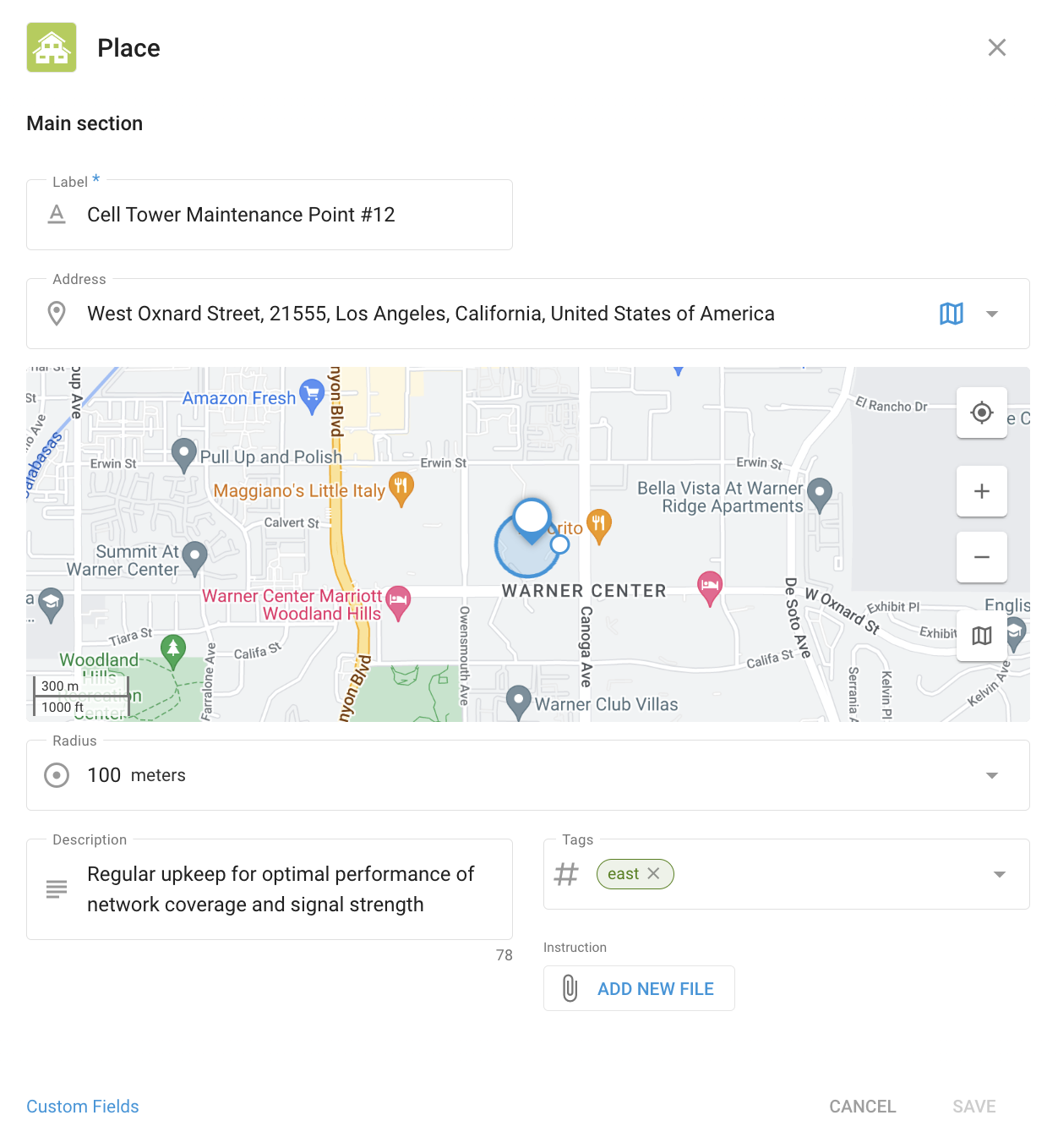
Creating a Place
Enter the Place's label, address, and radius. You can also add a description, tags, and a file.
{% endstep %}
{% step %}
#### (Optional) Add custom fields
Custom fields let you add extra details that aren't covered by the standard options. These fields are tailored to your business needs. They can include equipment type stored at the site, site maintenance schedule, security code, or manager contacts.
To manage custom fields, save the place, then reopen it and click **Custom fields** to open the **Custom fields** page for Places. Learn how to configure them in the [Custom fields](/docs/user/guide/account/custom-fields.md) article.
{% endstep %}
{% endstepper %}
## How to use Places
Places are used as a map tool to help you track your objects in the **Tracking** module. To learn more about their use for monitoring the map, see [Places (POIs)](/docs/user/guide/tracking/map-tools/places-pois.md). The **Tracking** module also allows [importing them](/docs/user/guide/tracking/map-tools/places-pois.md#importing-places-from-an-excel-file).
---
# Agent Instructions
This documentation is published with GitBook. GitBook is the documentation platform designed so that both humans and AI agents can read, navigate, and reason over technical content effectively. Learn more at gitbook.com.
## Querying This Documentation
If you need additional information that is not directly available in this page, you can query the documentation by asking a question.
Perform an HTTP GET request on the following URL with the `ask` and `goal` query parameters:
```
GET https://navixy.com/docs/user/guide/field-service/places-field-service.md?ask=&goal=
```
`ask` is the immediate question: it should be specific, self-contained, and written in natural language.
`goal` is what the user is ultimately trying to achieve, the reason they need the answer. Sharing it helps GitBook give you a better, more relevant answer. A goal is most helpful when it describes the outcome the user wants rather than restating the question. For example, with `ask=how do I create an API token`, a goal like `automate deployments from our CI pipeline` lets GitBook tailor the answer to that use case.
The response will contain a direct answer to the question and relevant excerpts and sources from the documentation.
Use this mechanism when the answer is not explicitly present in the current page, you need clarification or additional context, or you want to retrieve related documentation sections.